 The second video for UNKLE's 'The Answer', directed by Ross Cairns features footage from the Relentless ‘Lives of The Artists’ documentaries. The highly anticipated new installment, ‘Lives Of The Artists: Follow Me Down’ features James Lavelle and legendary backcountry snowboarders, Jeremy Jones and Xavier De La Rue.
Showing posts with label Nature. Show all posts
Showing posts with label Nature. Show all posts
Friday, 10 September 2010
Ross Cairns's The Answer music video for UNKLE
The second video for UNKLE's 'The Answer', directed by Ross Cairns features footage from the Relentless ‘Lives of The Artists’ documentaries. The highly anticipated new installment, ‘Lives Of The Artists: Follow Me Down’ features James Lavelle and legendary backcountry snowboarders, Jeremy Jones and Xavier De La Rue. 

Wednesday, 28 July 2010
Dirty Oil screening & QA with Producer Mark Cranwell and Chris Shearlock
 The Frontline Club are hosting a screening of Dirty Oil followed by a Q&A with Producer Mark Cranwell and Chris Shearlock, Environment Manager of The Co-operative Group
It is a little known fact that America imports the majority of its oil from Canada and not the Middle East. For years, Americans have been fueling what has been touted as the largest and most polluting industrial project on the planet today. Extracting oil from tar sands emits three times more greenhouse gas emissions than conventional oil and uses four times as much water and heat per barrel of oil. The demand and toll this process is taking on the land, air, water and wildlife around the Athabasca River and the downstream communities from Ft. McMurray is not only toxic but also irreversible. In early 2008 Babelgum, an online and mobile video service, which has a focus on environmental issues, commissioned its first original production from which Downstream and Dirty Oil are the result. Dirty Oil looks at an issue that is not just an Alberta or Canadian story but a global story. The oil sands have garnered an increasing amount of attention from all sides of the issue.
Narrated by Canadian actress Neve Campbell, this beautifully photographed feature documentary from Academy Award Nominated director Leslie Iwerks goes deep behind-the-scenes into the strip-mined world of Northern Alberta, Canada.
Here, vast and toxic oil sands supply the U.S. with the majority of its oil. Told through the eyes of scientists, "big oil" officials, politicians, doctors, environmentalists, and aboriginal citizens directly affected by "the largest industrial project on the planet today", the filmmakers journey to both sides of the border to uncover the emotional and irreversible impact this "black gold rush" is taking on our planet.
Dirty Oil is produced by Alberta born and Emmy Award winning producer Philip Alberstat, and co-produced by Mark Cranwell and Randy Bradshaw.
 Director: Leslie Iwerks
Starring: Neve Campbell, Andrew Nikiforuk, Lester Brown, Mike Hudema
France 2009, 73 mins, English
Dirty Oil screening & QA with Producer Mark Cranwell and Chris Shearlock
Where:
The Frontline Club, 13 Norfolk Place, London, W2 1QJ
7:00pm, Fri 30 Jul, 2010
More info:
And tickets over at the Frontline's website or http://www.dirtyoil.co.uk/
Saturday, 3 April 2010
Disneynature's Oceans Trailer
 Disneynature, the studio that presented the record-breaking film Earth, brings OCEANS to the big screen on Earth Day, 2010.
Nearly three-quarters of the Earth’s surface is covered by water, and OCEANS boldly chronicles the mysteries that lie beneath.
Directors Jacques Perrin and Jacques Cluzaud dive deep into the very waters that sustain all of mankind, exploring the harsh reality and the amazing creatures that live within. Featuring spectacular, never-before-seen imagery captured by the latest underwater technologies, OCEANS offers an unprecedented look beneath the sea in a powerful motion picture that unfolds on April 22, 2010.

Disneynature's Oceans Trailer
When
As yet Oceans 3D does not have a UK release date
More info at Disney OCEANS
Tuesday, 20 October 2009
Films on Foot: Film based walking tours of London
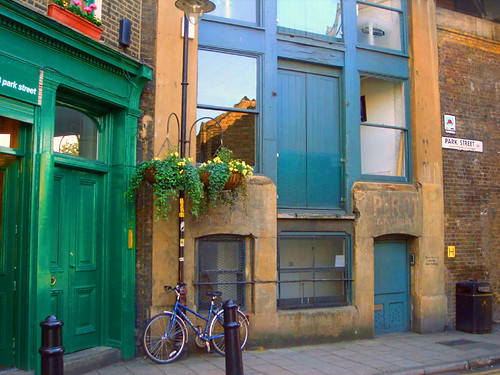
15 Park Street, Borough, SE1, The gang's hideout from Lock, Stock and Two Smoking Barrels
This autumn, the Ramblers, in association with Times BFI 53rd London Film Festival, will be holding an unmissable three week walking festival to celebrate London's world-class film heritage.
Timed to coincide with the Times BFI London Film Festival, the Ramblers second annual "Films on Foot" Festival (14 October-1 Novembwill er) see 9 walks focusing on different areas of London which have been stars of the big screen. The walks are free and open to everyone (new members are especially welcome). All the walks are led by volunteer members from the Metropolitan Walkers and the South Bank Ramblers Group.
The walks take place every Wednesday at 7pm, and every weekend at 1.30pm throughout the festival. There is no need to book, simply turn up at the meeting place indicated below.
An edit version of the programme is listed below:
Soho and the West End 'films on foot' walk - Wednesday 21 October 7pm
Join the Metropolitan Walkers for a 3 mile film stroll through Soho, the heart of the British film industry, and the West End with London's most famous landmarks captured on the big screen. The walk ends at a pub near Embankment tube station.
Notting Hill, Bayswater & Kensington Gardens - Saturday 24 October 1.30pm
Join the Metropolitan Walkers for a 8 mile film location walk This is a walk of contrasts taking in elegant 'Notting Hill' so popular with British romantic comedy film makers, the green space of Kensington Gardens and seedy Bayswater used in films such as 'Trainspotting'. The walk ends at a pub near Queensway tube station.
Isle of Dogs & Maritime Greenwich - Sunday 25 October 1.30pm
Join the South Bank Ramblers for a 5 mile film location walk through The Isle of Dogs - a frequent star of gangster and action films, and Maritime Greenwich - one of the most popular film locations in London. The walk ends at a pub in Greenwich.
Gangsters in the East End - Wednesday 28 October 7pm
Join the Metropolitan Walkers for a 3 mile stroll through the East End. This part of London was the play ground for real time villains, the Krays, and is a favourite film location for British gangster movies. The walk ends at a pub near Bethnal Green tube station.
Brompton Cemetery, Chelsea & Battersea Park - Saturday 31 October 1.30pm
Join the Metropolitan Walkers for a 6 mile film location walk. Brompton Cemetery and Battersea Park are two of the capital's most popular film locations, as well as being beautiful places to walk. The walk ends at a pub near Sloane Square tube station.
Westminster & the Royal Parks - Sunday 1 November 1.30pm
Join the Metropolitan Walkers for a 5 mile stroll taking film locations around Westminster and Belgravia, as well as the green spaces of St James's Park, Green Park and Hyde Park. The walk ends at a pub near Hyde Park Corner tube station.
For the full programme and information click here!
Monday, 21 September 2009
Tickets for Monday's screening of Disney's Crimson Flight & QA available
 One lake, a million birds, an incredible story
In a remote and forgotten wilderness, one of nature's last great mysteries unfolds: the birth, life and survival of a million crimson-winged flamingos. Against the dramatic backdrop of unforgiving, never-before filmed landscapes, we follow the birth of a tiny flamingo hatchling, and the perils and fortunes of her life in the extraordinary 'other world' of Lake Natron in northern Tanzania.
The first title to be released under the new Disneynature label, THE CRIMSON WING will take you on a breathtaking and beautiful journey through a story that only nature itself could tell.
To download tickets simply go to www.seefilmfirst.com and enter code: 482610
The film starts at 6.30pm. Seefilmfirst tickets must be changed for cinema tickets at the cinema Box Office by 6.15pm. There will be a Q&A with the films producers and director at the end.
Where
Cineworld Haymarket
63-65 Haymarket, London, SW1Y 4RL
When
6.15 for 6:30pm, 21 September, 2009
Wednesday, 26 August 2009
Preview of Big River Man and Q&A session with the Big River Man himself, in London

This formidable documentary follows overweight, middle-aged, alcoholic Slovenian daredevil environmentalist Martin Strel on a journey down the Amazon. Facing crocodiles, toxic waste, whirlpools, giant anacondas and piranhas, Strel attempts to swim the length of the mighty river, a seemingly impossible challenge that John Maringouin (director of a coruscating 2006 documentary about his father, Running Stumbled) captures in vivid style.
Preview Wednesday 2 September with a Q&A session featuring Martin Strel.
Preview of Big River Man and Q&A
Wednesday 2 September 2009 at 6:30pm
ICA Institute of Contemporary Arts
12 Carlton House Terrace
London, England SW1Y 5AH
Preview of Big River Man and Q&A session with the Big River Man himself, in London
This formidable documentary follows overweight, middle-aged, alcoholic Slovenian daredevil environmentalist Martin Strel on a journey down the Amazon. Facing crocodiles, toxic waste, whirlpools, giant anacondas and piranhas, Strel attempts to swim the length of the mighty river, a seemingly impossible challenge that John Maringouin (director of a coruscating 2006 documentary about his father, Running Stumbled) captures in vivid style.
Preview Wednesday 2 September with a Q&A session featuring Martin Strel.
Preview of Big River Man and Q&A
Wednesday 2 September 2009 at 6:30pm
ICA Institute of Contemporary Arts
12 Carlton House Terrace
London, England SW1Y 5AH
Thursday, 18 September 2008
IMAX preview screening of STEEP
We are delighted to invite you to an exclusive IMAX preview screening of 'STEEP'. The screening is taking place on Saturday 20th September at the awesome BFI IMAX, Waterloo, London.

THE FILM WILL START PROMPTLY, but we advise that you aim to arrive at the cinema 30 minutes earlier. You will not be sent tickets. Your name has been added to the guest list which will be on the door on the morning of the screening. We look forward to seeing you there,
Warning: You're about to experience the most breath-taking, exhilarating and inspirational ride of your life.
The world's best skiers go beyond their dreams to conquer the steepest runs ever faced. These extremers risk their lives for a thrill but what a thrill it is. Fantastically beautiful images of the most magnificent peaks on the globe along with devastating avalanches and fatal spills only serve to push them harder.
'Awesome...breath-taking' The Cooler
'Very impressive' Empire
'Looks so perfect you're be hard pressed to believe it wasn't CGI.
Catch it an an IMAX if you can.' Little White Lies
Featuring Seth Morrison and the late Doug Coombs, Steep is a feature documentary about bold adventure, exquisite athleticism and the pursuit of a perfect moment on skis.
Steep (Digital Cinema Presentation) opens exclusively at the BFI IMAX on 26 September.
For more details go to www.bfi.org.uk/imax
See the trailer at www.nevertoosteep.com

THE FILM WILL START PROMPTLY, but we advise that you aim to arrive at the cinema 30 minutes earlier. You will not be sent tickets. Your name has been added to the guest list which will be on the door on the morning of the screening. We look forward to seeing you there,
Warning: You're about to experience the most breath-taking, exhilarating and inspirational ride of your life.
The world's best skiers go beyond their dreams to conquer the steepest runs ever faced. These extremers risk their lives for a thrill but what a thrill it is. Fantastically beautiful images of the most magnificent peaks on the globe along with devastating avalanches and fatal spills only serve to push them harder.

'Awesome...breath-taking' The Cooler
'Very impressive' Empire
'Looks so perfect you're be hard pressed to believe it wasn't CGI.
Catch it an an IMAX if you can.' Little White Lies
Featuring Seth Morrison and the late Doug Coombs, Steep is a feature documentary about bold adventure, exquisite athleticism and the pursuit of a perfect moment on skis.
Steep (Digital Cinema Presentation) opens exclusively at the BFI IMAX on 26 September.
For more details go to www.bfi.org.uk/imax
See the trailer at www.nevertoosteep.com
Friday, 8 June 2007
Meerkats at London Zoo, London
Meerkats at London Zoo

Meerkat or Mongoose (Suricatta suricata)
Highly sociable, these mongooses live in extensive burrow systems. One of the group acts as sentry on a high vantage point, while the others forage for food. Black hair around their eyes enables them to scan the bright sky for predators and a variety of calls warns the group to hide when danger is near.
ZSL London Zoo
ZSL London Zoo is the world's oldest scientific zoo.It was opened in London on April 27, 1828,and was originally intended to be used as a collection for scientific study. It was eventually made open to the public in 1847. Today it houses a collection of 755 species of animals, with 15104 individuals, making it one of the largest collections in the United Kingdom.
It is managed under the aegis of the Zoological Society of London (established in 1826),and is situated at the northern edge of Regent's Park (the Regent's Canal runs through it).The Society also has a more spacious site at ZSL Whipsnade Zoo in Bedfordshire to which the larger animals such as elephants and rhinos have been moved. As well as being the first scientific zoo, ZSL London Zoo also opened the first Reptile house (1849), first public Aquarium (1853), first insect house (1881) and the first children's zoo (1938).
ZSL receives no state funding and relies on 'Fellows', 'Friends', 'Members', entrance fees and sponsorship to generate income.
Western Lowland Gorilla at London Zoo, London
Western lowland gorilla at London Zoo

Western lowland gorilla (Gorilla gorilla gorilla)
The largest apes, gorillas are threatened by deforestation and the bushmeat trade. They are gentle, social primates. A silverback male leads a group of several females and their offspring.
ZSL London Zoo
ZSL London Zoo is the world's oldest scientific zoo.It was opened in London on April 27, 1828,and was originally intended to be used as a collection for scientific study. It was eventually made open to the public in 1847. Today it houses a collection of 755 species of animals, with 15104 individuals, making it one of the largest collections in the United Kingdom.
It is managed under the aegis of the Zoological Society of London (established in 1826),and is situated at the northern edge of Regent's Park (the Regent's Canal runs through it).The Society also has a more spacious site at ZSL Whipsnade Zoo in Bedfordshire to which the larger animals such as elephants and rhinos have been moved. As well as being the first scientific zoo, ZSL London Zoo also opened the first Reptile house (1849), first public Aquarium (1853), first insect house (1881) and the first children's zoo (1938).
ZSL receives no state funding and relies on 'Fellows', 'Friends', 'Members', entrance fees and sponsorship to generate income.
Sumatran Tiger at London Zoo, London
Sumatran tiger at London Zoo

Sumatran tiger (Panthera tigris sumatrae)
Their stripes provide good camouflage in the tropical forests where they live. They also have spots on the back of their ears that they use for signalling. Sumatran tigers are smaller and darker than the Amur (Siberian) tigers that are kept at Whipsnade Wild Animal Park.
ZSL London Zoo
ZSL London Zoo is the world's oldest scientific zoo.It was opened in London on April 27, 1828,and was originally intended to be used as a collection for scientific study. It was eventually made open to the public in 1847. Today it houses a collection of 755 species of animals, with 15104 individuals, making it one of the largest collections in the United Kingdom.
It is managed under the aegis of the Zoological Society of London (established in 1826),and is situated at the northern edge of Regent's Park (the Regent's Canal runs through it).The Society also has a more spacious site at ZSL Whipsnade Zoo in Bedfordshire to which the larger animals such as elephants and rhinos have been moved. As well as being the first scientific zoo, ZSL London Zoo also opened the first Reptile house (1849), first public Aquarium (1853), first insect house (1881) and the first children's zoo (1938).
ZSL receives no state funding and relies on 'Fellows', 'Friends', 'Members', entrance fees and sponsorship to generate income.
Wednesday, 6 June 2007
Shark Observatory, Shark Reef, Ras Mohammed, Egypt
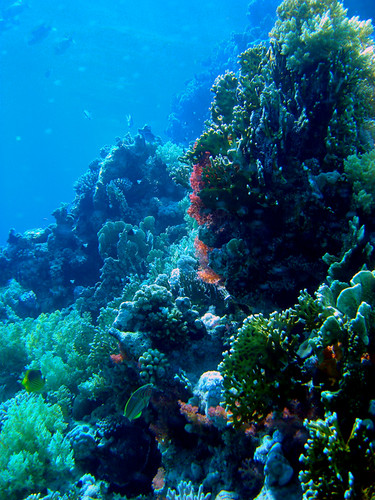
Shark Observatory
The site stretches from the foot of the observatory cliff in the north, across the mouth of a shallow box-shaped inlet, to the beginning of the Anemone City in the south. There are two possible shore entry points, one inside the inlet and the second in the small cove at the foot of the cliff. Both can be reached by road.
In the past, it was possible to see sharks here just by looking down from the cliff top but with the advent of dive tourism and its attendant boat traffic, the sharks have mostly moved on.
The site is a vertical wall, sloping outwards at its foot. The rugged profile is most dramatic in the northern section, where the reef face is especially contoured, with fissures, inlets and crevices to explore. Coral growth is good with lots of variety among both soft and stony species.
The steep profile does not encourage dense populations of smaller reef species, so quality and quantity of fish are somewhat dependent on currents and the pelagic life they encourage. Jacks, barracuda and the occasional gray or blacktip shark liven things up when the current is running: snapper, surgeons and unicorns are present in schools of varying size, and larger reef fish such as big grouper and Napoleons are usually on hand.
Divers should be careful of the strong currents which are common in this area and those who enter from shore should be doubly cautious. Once beyond the point to the north, there is no shore exit point. Do not round the point if current could prevent you from returning to the exit point.
Ras Mohammed is the National Park of South Sinai and located on the very tip of the Sinai Peninsula; it probably represents some of the most famous dive sites in the Red Sea with 800-metre (2,600 ft) deep reef walls and pounding current and coral gardens.
Shark Reef, Ras Mohammed, Egypt
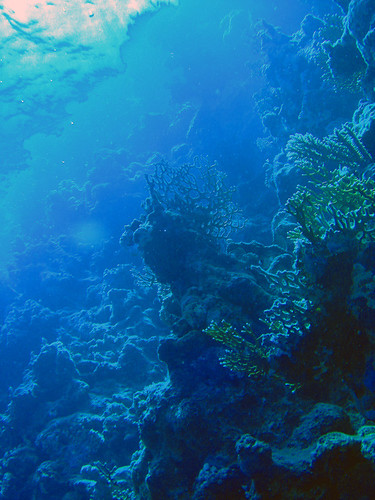
Shark Reef and Yolanda Reef are two reefs rising just off the Ras Mohammed coast. They are twin peaks of a single coral sea mount, separated from the mainland by a shallow channel.
Shark Reef is the more colorful and spectacular of the two reefs; with its wall and great marine life. Yolanda Reef is the larger of the two. Its name comes from a vessel which sank here in 1980.
Sharm el-Sheikh has also become a favourite spot for scuba divers from around the world. Being situated near to the Red Sea, it provides some of the most stunning underwater scenery and warm water making this an ideal place to dive. Visitors to Sharm el-Sheikh can experience a variety of water and activities. Beach seekers find many activities such as diving, snorkeling, wind surfing, para-sailing, boating, and canoeing.
Ras Mohammed is the National Park of South Sinai and located on the very tip of the Sinai Peninsula; it probably represents some of the most famous dive sites in the Red Sea with 800-metre (2,600 ft) deep reef walls and pounding current and coral gardens.
By boat & from shore: Long boat time (> 30min)
average depth: 20.0 m
max depth: 50.0 m
visibility:Good ( 10 - 30 m)
dive type: Sharks & Reef
Baby Giant Moray Eel, Shark Reef, Ras Mohammed, Egypt

The giant moray is widespread in the Indo-Pacific region, being found in the Red Sea and East Africa, the Pitcairn group, north to the Ryukyu and Hawaiian islands, south to New Caledonia and the Austral Islands.
As the name suggests, this is a large eel, reaching up to 300cm (9.8 ft) in length and 30kg (66.1 lbs) in weight. While juveniles are tan in colour with large black spots, adults have black specks that grade into leopard-like spots behind the head and a black area surrounding the gill opening.
Shark Reef and Yolanda Reef are two reefs rising just off the Ras Mohammed coast. They are twin peaks of a single coral sea mount, separated from the mainland by a shallow channel.
Shark Reef is the more colorful and spectacular of the two reefs; with its wall and great marine life. Yolanda Reef is the larger of the two. Its name comes from a vessel which sank here in 1980.
Ras Mohammed is the National Park of South Sinai and located on the very tip of the Sinai Peninsula; it probably represents some of the most famous dive sites in the Red Sea with 800-metre (2,600 ft) deep reef walls and pounding current and coral gardens.
Giant Gorgonian, Shark Reef, Mohammed, Egypt
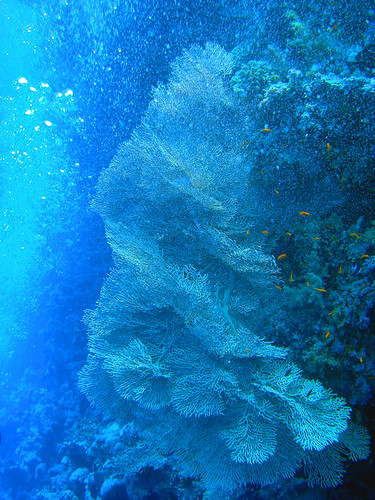
Shark Reef and Yolanda Reef are two reefs rising just off the Ras Mohammed coast. They are twin peaks of a single coral sea mount, separated from the mainland by a shallow channel.
Shark Reef is the more colourful and spectacular of the two reefs; with its wall and great marine life. Yolanda Reef is the larger of the two. Its name comes from a vessel which sank here in 1980.
Two ergs rise up from a vertical wall with a drop off down to 300 metres. The dive begins at shark reef and continues with the current until reaching the cargo of the Jolanda, where the sea floor rises to about 15-25 metres and is strewn with toilets. There are lots of schools of fish and other sea life including stone fish and scorpion fish. Large pelagics may gather beyond the reef, so keep watching the open sea.The water here is truly deep and as you look down the vertical wall the water takes on an inky dark feel, even though viz is often in excess of 30m. An ideal start depth here would be the 30-40m mark, where if the current allows it is worth spending some time looking out into the blue.
Whilst a little more rare these days it is still possible to see white-tip reef sharks and if you're lucky larger grey reef sharks identifiable by the thick black strip which runs all the way down the rear of their tail fins. Scalloped hammerhead have been spotted as well. Also look out for barracuda, jacks and tuna. The reef itself on the eastern side of Shark Reef is fed by nutrients from the sometimes strong currents and as a result there are some beautiful gorgonian fan corals and black whip coral. The deeper part of the reef has a proliferation of soft coral from the 30m - 70m range. Soft coral requires much less light than hard coral and seems to thrive in this inky abyss. Once you have spent some time on the east side of Shark Reef, or if the current is running, then turn and with your right shoulder reef side head southwest around the reef. You will see the reef wall sloping up beneath you as you head towards the gap between Shark Reef and Jolanda and you drift over a rising plateau.
Ras Mohammed is the National Park of South Sinai and located on the very tip of the Sinai Peninsula; it probably represents some of the most famous dive sites in the Red Sea with 800-metre (2,600 ft) deep reef walls and pounding current and coral gardens.
Giant Gorgonian, Shark Reef, Ras Mohammed, Egypt
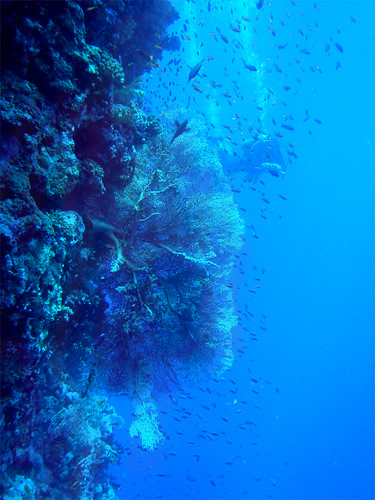
Shark Reef and Yolanda Reef are two reefs rising just off the Ras Mohammed coast. They are twin peaks of a single coral sea mount, separated from the mainland by a shallow channel.
Shark Reef is the more colourful and spectacular of the two reefs; with its wall and great marine life. Yolanda Reef is the larger of the two. Its name comes from a vessel which sank here in 1980.
Two ergs rise up from a vertical wall with a drop off down to 300 metres. The dive begins at shark reef and continues with the current until reaching the cargo of the Jolanda, where the sea floor rises to about 15-25 metres and is strewn with toilets. There are lots of schools of fish and other sea life including stone fish and scorpion fish. Large pelagics may gather beyond the reef, so keep watching the open sea.The water here is truly deep and as you look down the vertical wall the water takes on an inky dark feel, even though viz is often in excess of 30m. An ideal start depth here would be the 30-40m mark, where if the current allows it is worth spending some time looking out into the blue.
Whilst a little more rare these days it is still possible to see white-tip reef sharks and if you're lucky larger grey reef sharks identifiable by the thick black strip which runs all the way down the rear of their tail fins. Scalloped hammerhead have been spotted as well. Also look out for barracuda, jacks and tuna. The reef itself on the eastern side of Shark Reef is fed by nutrients from the sometimes strong currents and as a result there are some beautiful gorgonian fan corals and black whip coral. The deeper part of the reef has a proliferation of soft coral from the 30m - 70m range. Soft coral requires much less light than hard coral and seems to thrive in this inky abyss. Once you have spent some time on the east side of Shark Reef, or if the current is running, then turn and with your right shoulder reef side head southwest around the reef. You will see the reef wall sloping up beneath you as you head towards the gap between Shark Reef and Jolanda and you drift over a rising plateau.
Black Spotted Pufferfish, Shark Reef, Mohammed, Egypt
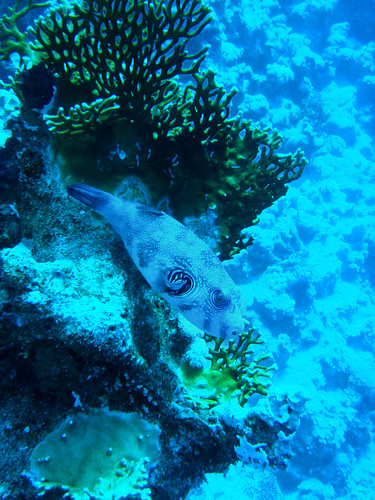
This Black-spotted puffer is very common sight in Ras Mohammad. This one is on the move, but these gentle, solitary fish may often be seen resting in a sponge or among coral branches. As with the other types of nearly 90 species of pufferfish, they inflate themselves by gulping down water when disturbed. Unlike the thick-skinned porcupinefish (also of family Tetradontidae, "fused teeth"), the Black-spotted puffer has relatively thin skin and small, short spines. This one is about seven inches in length. This species may vary from a gray base color to yellow. Pufferfish are also known as "blowfish" or "globefish".
Shark Reef and Yolanda Reef are two reefs rising just off the Ras Mohamed coast. They are twin peaks of a single coral sea mount, separated from the mainland by a shallow channel.
Shark Reef is the more colourful and spectacular of the two reefs; with its wall and great marine life. Yolanda Reef is the larger of the two. Its name comes from a vessel which sank here in 1980.
Ras Mohammed is the National Park of South Sinai and located on the very tip of the Sinai Peninsula; it probably represents some of the most famous dive sites in the Red Sea with 800-metre (2,600 ft) deep reef walls and pounding current and coral gardens.
Shark Observatory, Shark Reef, Mohammed, Egypt
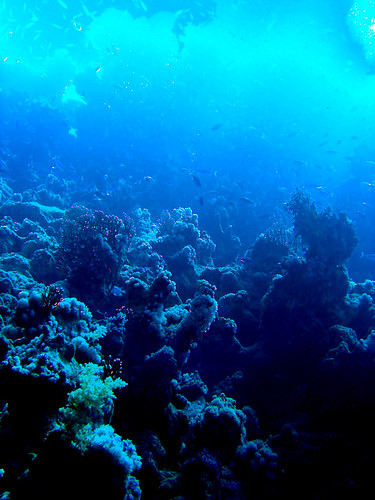
Shark Observatory
The site stretches from the foot of the observatory cliff in the north, across the mouth of a shallow box-shaped inlet, to the beginning of the Anemone City in the south. There are two possible shore entry points, one inside the inlet and the second in the small cove at the foot of the cliff. Both can be reached by road.
In the past, it was possible to see sharks here just by looking down from the cliff top but with the advent of dive tourism and its attendant boat traffic, the sharks have mostly moved on.
The site is a vertical wall, sloping outwards at its foot. The rugged profile is most dramatic in the northern section, where the reef face is especially contoured, with fissures, inlets and crevices to explore. Coral growth is good with lots of variety among both soft and stony species.
The steep profile does not encourage dense populations of smaller reef species, so quality and quantity of fish are somewhat dependent on currents and the pelagic life they encourage. Jacks, barracuda and the occasional gray or blacktip shark liven things up when the current is running: snapper, surgeons and unicorns are present in schools of varying size, and larger reef fish such as big grouper and Napoleons are usually on hand.
Divers should be careful of the strong currents which are common in this area and those who enter from shore should be doubly cautious. Once beyond the point to the north, there is no shore exit point. Do not round the point if current could prevent you from returning to the exit point.
Ras Mohammed is the National Park of South Sinai and located on the very tip of the Sinai Peninsula; it probably represents some of the most famous dive sites in the Red Sea with 800-metre (2,600 ft) deep reef walls and pounding current and coral gardens.
Shark Reef, Ras Mohammed, Egypt

Shark Reef and Yolanda Reef are two reefs rising just off the Ras Mohamed coast. They are twin peaks of a single coral sea mount, separated from the mainland by a shallow channel.
Shark Reef is the more colorful and spectacular of the two reefs; with its wall and great marine life. Yolanda Reef is the larger of the two. Its name comes from a vessel which sank here in 1980.
Sharm el-Sheikh has also become a favourite spot for scuba divers from around the world. Being situated near to the Red Sea, it provides some of the most stunning underwater scenery and warm water making this an ideal place to dive. Visitors to Sharm el-Sheikh can experience a variety of water and activities. Beach seekers find many activities such as diving, snorkeling, wind surfing, para-sailing, boating, and canoeing.
Ras Mohammed is the National Park of South Sinai and located on the very tip of the Sinai Peninsula; it probably represents some of the most famous dive sites in the Red Sea with 800-metre (2,600 ft) deep reef walls and pounding current and coral gardens.
By boat & from shore: Long boat time (> 30min)
average depth: 20.0 m
max depth: 50.0 m
visibility:Good ( 10 - 30 m)
dive type: Sharks &Reef
Red Sea, Ras Mohammad, Egypt
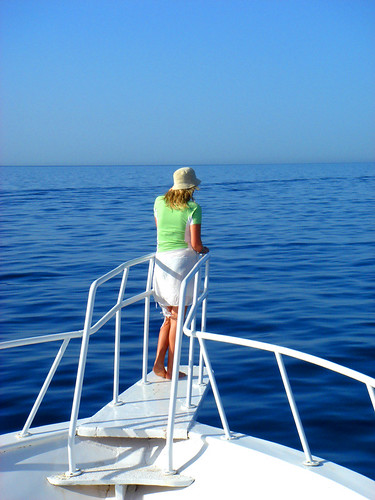
The Red Sea is a salt water inlet of the Indian Ocean between Africa and Asia. The connection to the ocean is in the south through the Bab el Mandeb sound and the Gulf of Aden. In the north are the Sinai Peninsula, the Gulf of Aqaba, and the Gulf of Suez (leading to the Suez Canal). The Red Sea is a Global 200 ecoregion. The Red Sea was also historically known as the Arabian Gulf, although recently Pan-Arabist nationalists sought to change the Persian Gulf's name to the Arabian Gulf.
Occupying a part of the Great Rift Valley, the Red Sea has a surface area of about 438,000 km² (169,100 square miles ). It is roughly 2250 km (1398 mi) long and, at its widest point at 355 km (220.6 miles) wide. It has a maximum depth of 2211 m (7254 ft) in the central median trench and an average depth of 490 m (1,608 feet ), but there are also extensive shallow shelves, noted for their marine life and corals. The sea is the habitat of over 1,000 invertebrate species and 200 soft and hard corals and is the world's northernmost tropical sea.
Ras Mohammad (Arabic: رأس محمد) is a national park located in Egypt at the southern extreme of the Sinai Peninsula, overlooking the Gulf of Suez on the west and the Gulf of Aqaba to the east.
Subscribe to:
Posts (Atom)