View Larger Map
Wednesday, 30 December 2009
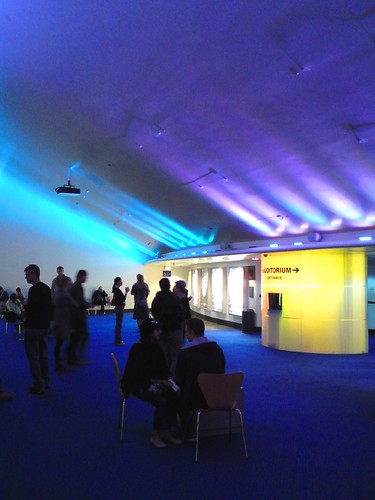
The Screening Room at Alfred Dunhill
View Larger Map
Thursday, 18 September 2008
IMAX preview screening of STEEP

THE FILM WILL START PROMPTLY, but we advise that you aim to arrive at the cinema 30 minutes earlier. You will not be sent tickets. Your name has been added to the guest list which will be on the door on the morning of the screening. We look forward to seeing you there,
Warning: You're about to experience the most breath-taking, exhilarating and inspirational ride of your life.
The world's best skiers go beyond their dreams to conquer the steepest runs ever faced. These extremers risk their lives for a thrill but what a thrill it is. Fantastically beautiful images of the most magnificent peaks on the globe along with devastating avalanches and fatal spills only serve to push them harder.
'Awesome...breath-taking' The Cooler
'Very impressive' Empire
'Looks so perfect you're be hard pressed to believe it wasn't CGI.
Catch it an an IMAX if you can.' Little White Lies
Featuring Seth Morrison and the late Doug Coombs, Steep is a feature documentary about bold adventure, exquisite athleticism and the pursuit of a perfect moment on skis.
Steep (Digital Cinema Presentation) opens exclusively at the BFI IMAX on 26 September.
For more details go to www.bfi.org.uk/imax
See the trailer at www.nevertoosteep.com
Friday, 1 February 2008
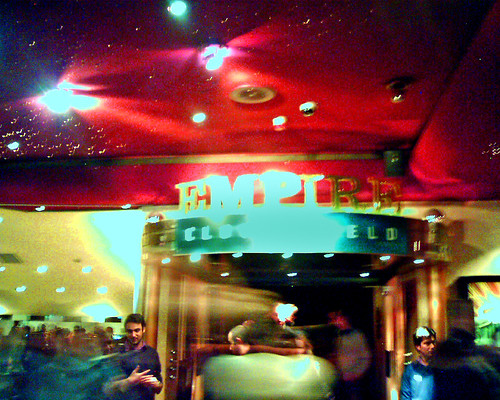
The Empire, Leicester square, London for Cloverfield
Cloverfield is a 2008 monster/horror film directed by Matt Reeves, produced by J. J. Abrams and written by Drew Goddard.
Before the film's release Paramount Pictures carried out a viral marketing campaign to promote the film. The campaign included viral tie-ins similar to Lost Experience.The film follows five young New Yorkers attending a going-away party on the night that a gigantic monster attacks the city. First publicized within a teaser trailer in screenings of Transformers, the film was released on January 17 in New Zealand and Australia, on January 18 in North America, on January 24 in South Korea and on February 1 in Ireland, in the UK and in Italy. In Japan, the film was released on April 5. This film has been nominated for a UL Media Award for "Best Dramatic Film."
VFX and CGI were performed by effects studios Double Negative and Tippett Studio. The film has grossed $29,259,507 in DVD sales, bringing its total film gross to $199,861,825.
The Empire
The Empire is a large cinema on the north side of Leicester Square, in the City of Westminster, London. It is one of many large cinemas in, and adjoining, the square which are used for film premières and first runs. The original structure was built
in 1884, as a theatre, designed by Thomas Verity. In common with many of the cinemas that are now in the square, parts of the original structure may still remain, but are hidden by its modern adaption.
The Empire 1 screen is the largest, with a seating capacity of 1330 since its last major refurbishment in the mid-1960s. Empire 2, seating 349, was formerly a separate cinema called The Ritz, located below ground. Since the 1960s refurbishment, the screen has been part of The Empire (although it had a separate entrance until a small refurbishment in the mid-1980s). Empire 3 is a small screen with only a 77-seat capacity. In spring 2008, two further small screens were added; Empire 4 with 96 seats and Empire 5 with 50 seats. Empires 1, 4 & 5 support digital projection.
For a period in the early-to-mid 1990s, the Empire 1 was notable for the short sound-and-light show, involving laser projections onto the curtains and walls, that preceded the start of each programme.
In October 2005, the Empire was sold to Empire Cinemas Ltd, along with ten other cinemas around the UK, following instructions from the Office of Fair Trading that Terra Firma Capital Partners divest of 11 cinemas in order that their acquisition of United Cinemas International go ahead.
On 2 April 2006, Irish newspapers reported that all of theatres which were recently acquired by Empire Cinemas will be rebranded under the Empire brand.
In the Summer of 2006, the Empire 1 sound system was completely overhauled, installing a 56 kilowatt THX certified sound system. At the same time as this the screen size was expanded by approximately 4 metres.
Thursday, 26 January 2006
Decoding Video Codecs
Decoding The Codecs
A codec is a formula that removes data - redundant data, data you aren't likely to notice, data that can be derived from other data, and so on - so files can be transmitted more quickly. At the receiving end, a decoder reassembles the data into something coherent.
The Wired article goes into detail about various popular Codec formats including:
a2b (AT&T)
Emblaze (Geo Interactive)
GTS (Graham Technology Solutions)
JPEG (public domain) JPEG(Joint Photographic Experts Group)
Liquid Audio (Liquid Audio)
MP3 (Fraunhofer Institute, Thomson Multimedia)
MPEG-1 (Philips and others)
MPEG-2 (MPEG-LA Consortium)
QDesign Music (QDesign)
QuickTime 2.5 and 3.0 (Apple)
RealMedia 5.0 and G2 (RealNetworks)
Sorenson Video (SorensonVision)
Windows Media Technologies (Microsoft)
Read more over here!
Wednesday, 25 January 2006
HDTV
Superior resolution HDTV offers a number of compelling advantages over its analog forbears. The primary reason is enhanced resolution. A TV picture is made up of lots of tiny horizontal rows (called scan lines) of individual pixels, or picture elements. The more rows—and the more picture elements—a screen can reproduce, the clearer and sharper the picture. Your old analog TV’s picture is made up of 480 visible horizontal lines, each comprising a maximum of 720 pixels. By contrast, HDTVs can reproduce up to 1080 horizontal lines of 1920 pixels—resulting in a jaw-dropping picture that’s six times as dense. HDTV also has the advantage of enabling progressive-scan display (useful with the latest DVD players and gaming systems, as well as TV broadcasts).
Oh and...
You’ve probably also noticed that many HDTV screens are wider, relative to their height, than the TVs you’re accustomed to. To be specific, most newer HDTV models feature what’s known as a 16:9 (widescreen) aspect ratio (the ratio refers to the relationship between horizontal and vertical dimensions), as compared to the 4:3 aspect ratio of older TVs. HDTV programming, by definition, is delivered in this wider aspect, which is better suited to the reproduction of most movies, not to mention providing a broader, more revealing perspective on sporting events and other programs. Regardless of their screen dimensions, all HDTVs and HD-ready TVs can reproduce high-definition programming in its intended 16:9 aspect. 4:3 sets typically handle the conversion by compressing the horizontal scan lines to fit within the vertical picture area, leaving black or gray bars above and below the image (letterboxing).
Tuesday, 24 January 2006
Interlaced Scan Rendering (TV broadcast formats)
NTSC
NTSC is based on a 525-line, 60 fields/30 frames-per-second at 60Hz system for transmission and display of video images. This is an interlaced system in which each frame is scanned in two fields of 262 lines, which is then combined to display a frame of video with 525 scan lines. NTSC is the official analog video standard in the U.S., Canada, Mexico, some parts of Central and South America, Japan, Taiwan, and Korea.
PALPAL is the dominant format in the World for analog television broadcasting and video display (sorry U.S.) and is based on a 625 line, 50 field/25 frames a second, 50HZ system. The signal is interlaced, like NTSC, into two fields, composed of 312 lines each. Several distinguishing features are one: A better overall picture than NTSC because of the increased amount of scan lines. Two: Since color was part of the standard from the beginning, color consistency between stations and TVs are much better. In addition, PAL has a frame rate closer to that of film. PAL has a 25 frames per second rate, while film has a frame rate of 24 frames per second. Countries on the PAL system include the U.K., Germany, Spain, Portugal, Italy, China, India, most of Africa, and the Middle East.
Friday, 13 January 2006
Cinema Sound Formats
Dolby Digital is a digital encoding system for audio signals that can be decoded by a receiver or preamplifier with a Dolby Digital decoder.
Dolby Digital is often referred to as a 5.1 channel surround system. However, it must be noted that term "Dolby Digital" refers to the digital encoding of the audio signal, not how many channels it has. In other words, Dolby Digital can be Monophonic, 2-channel, 4-channel, 5.1 channels, or 6.1 channels. However, in its most common applications, Dolby Digital 5.1 and 6.1 are often referred to as just Dolby Digital.