Critical Mass is an event typically held on the last Friday of every month in cities around the world where bicyclists take to the streets en masse. While the ride was originally founded with the idea of drawing attention to how unfriendly the city was to bicyclists, the leaderless structure of Critical Mass makes it impossible to assign it any one specific goal.
We are not sure, opinions seem to differ. There are probably as many aims of CM as there are participants. Each individual comes there with his or her own idea of what it's about, and the sum of this makes up the Mass. We have no organisers and no planned routes.
Showing posts with label Experiences. Show all posts
Showing posts with label Experiences. Show all posts
Friday, 26 September 2008


Critical Mass come together Waterloo, London

Critical Mass is an event typically held on the last Friday of every month in cities around the world where bicyclists take to the streets en masse.
Critical Mass has became a form of criticism towards car-oriented cities, pollution, and lack of environmental commitment all over the world.
On my way to Critical Mass, London
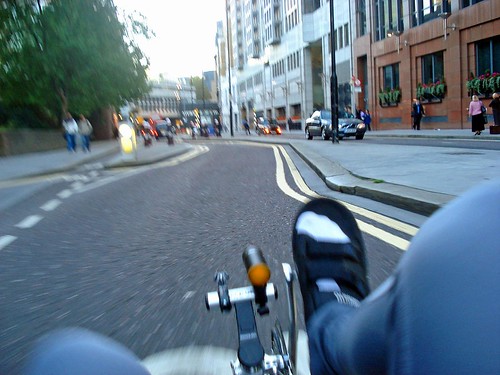
Critical Mass is an event typically held on the last Friday of every month in cities around the world where bicyclists take to the streets en masse.
While the ride was originally founded with the idea of drawing attention to how unfriendly the city was to bicyclists, the leaderless structure of Critical Mass makes it impossible to assign it any one specific goal.
Wednesday, 9 April 2008
Another day in the office, London
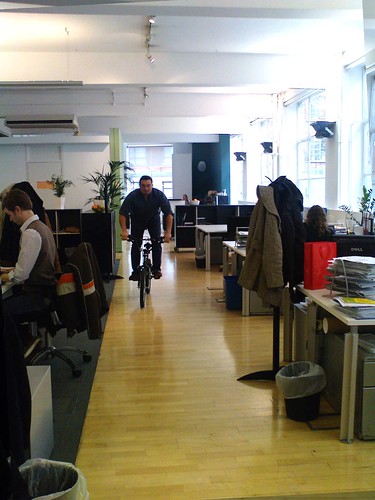
Fizzy bought a BMX recently I couldn't resist a quick ride to recall the glory days of Bicycle Motor Cross at Greenpoint BMX track.
This is me about 4 seconds before pulling off an Endo.
Saturday, 14 July 2007
Day at Ascot races with Lemar performing live
Day at Ascot races with Lemar performing live

Ascot races
Ascot, founded in 1711 by Queen Anne, is one of the world's greatest racecourses and the best racecourse in the UK.
It was while Queen Anne was out riding on the edge of Windsor Great Park that she noticed a natural clearing near the village of East Cote, now called Ascot. Queen Anne ordered a course to be laid out 'for horses to gallop at full stretch' and so the Royal Racecourse was born. The first four-day Royal Meeting was held in June 1768, changing to a five day meeting in 2002, the Queen's Golden Jubilee year. Today Ascot Racecourse stages the highest quality flat and jump racing throughout the year and is undoubtedly the best racecourse in the world.
Lemar
Lemar Obika (born 4 April 1978), professionally known as Lemar, is a British Soul and R&B Singer, Songwriter and Vocal Producer who has had a run of chart success in the United Kingdom, Europe and Australia.
Lemar was most notably brought to public attention on the BBC's Fame Academy in 2002, a combination of a talent quest and reality television show. He made the finals of the show winning plaudits for his version of "Let's Stay Together" by Al Green and singing a duet with Lionel Richie on "Easy". While he ended up finishing third in the show, which was won by David Sneddon, he caught the eye of fellow English soul singer Beverley Knight, who invited him to sing a duet with her during her concert at the Hammersmith Apollo. Sony Music was so impressed with his potential that they signed him to a five year record deal worth £1 million.
Day at Ascot races
Ascot, founded in 1711 by Queen Anne, is one of the world's greatest racecourses and the best racecourse in the UK.

It was while Queen Anne was out riding on the edge of Windsor Great Park that she noticed a natural clearing near the village of East Cote, now called Ascot. Queen Anne ordered a course to be laid out 'for horses to gallop at full stretch' and so the Royal Racecourse was born. The first four-day Royal Meeting was held in June 1768, changing to a five day meeting in 2002, the Queen's Golden Jubilee year. Today Ascot Racecourse stages the highest quality flat and jump racing throughout the year and is undoubtedly the best racecourse in the world.
Sunday, 1 July 2007
The Chap Olympics
An afternoon of idiosyncratic sporting delights. From the site:
"The single sporting event of the season in which buffoonery, ineptitude and panache are rewarded. The events may all be entered by members of the public, as long as they are adequately attired and not wearing sportswear."
Website: http://www.thechap.net/content/section_news/chap-events.html
Bedford Square
London, England WC1B 3ED
"The single sporting event of the season in which buffoonery, ineptitude and panache are rewarded. The events may all be entered by members of the public, as long as they are adequately attired and not wearing sportswear."
Website: http://www.thechap.net/content/section_news/chap-events.html
The Chap Olympics
Saturday July 14, 2007 from 1:00pm - 6:00pm
Bedford SquareBedford Square
London, England WC1B 3ED
Wednesday, 6 June 2007
Shark Observatory, Shark Reef, Ras Mohammed, Egypt
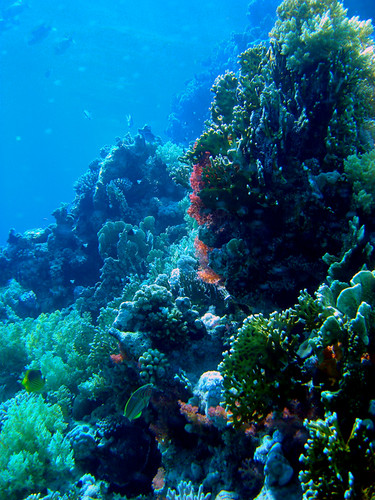
Shark Observatory
The site stretches from the foot of the observatory cliff in the north, across the mouth of a shallow box-shaped inlet, to the beginning of the Anemone City in the south. There are two possible shore entry points, one inside the inlet and the second in the small cove at the foot of the cliff. Both can be reached by road.
In the past, it was possible to see sharks here just by looking down from the cliff top but with the advent of dive tourism and its attendant boat traffic, the sharks have mostly moved on.
The site is a vertical wall, sloping outwards at its foot. The rugged profile is most dramatic in the northern section, where the reef face is especially contoured, with fissures, inlets and crevices to explore. Coral growth is good with lots of variety among both soft and stony species.
The steep profile does not encourage dense populations of smaller reef species, so quality and quantity of fish are somewhat dependent on currents and the pelagic life they encourage. Jacks, barracuda and the occasional gray or blacktip shark liven things up when the current is running: snapper, surgeons and unicorns are present in schools of varying size, and larger reef fish such as big grouper and Napoleons are usually on hand.
Divers should be careful of the strong currents which are common in this area and those who enter from shore should be doubly cautious. Once beyond the point to the north, there is no shore exit point. Do not round the point if current could prevent you from returning to the exit point.
Ras Mohammed is the National Park of South Sinai and located on the very tip of the Sinai Peninsula; it probably represents some of the most famous dive sites in the Red Sea with 800-metre (2,600 ft) deep reef walls and pounding current and coral gardens.
Shark Reef, Ras Mohammed, Egypt
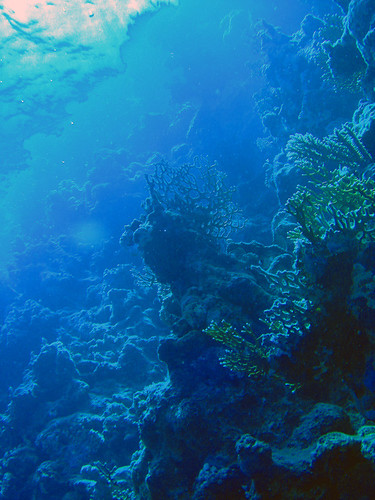
Shark Reef and Yolanda Reef are two reefs rising just off the Ras Mohammed coast. They are twin peaks of a single coral sea mount, separated from the mainland by a shallow channel.
Shark Reef is the more colorful and spectacular of the two reefs; with its wall and great marine life. Yolanda Reef is the larger of the two. Its name comes from a vessel which sank here in 1980.
Sharm el-Sheikh has also become a favourite spot for scuba divers from around the world. Being situated near to the Red Sea, it provides some of the most stunning underwater scenery and warm water making this an ideal place to dive. Visitors to Sharm el-Sheikh can experience a variety of water and activities. Beach seekers find many activities such as diving, snorkeling, wind surfing, para-sailing, boating, and canoeing.
Ras Mohammed is the National Park of South Sinai and located on the very tip of the Sinai Peninsula; it probably represents some of the most famous dive sites in the Red Sea with 800-metre (2,600 ft) deep reef walls and pounding current and coral gardens.
By boat & from shore: Long boat time (> 30min)
average depth: 20.0 m
max depth: 50.0 m
visibility:Good ( 10 - 30 m)
dive type: Sharks & Reef
Baby Giant Moray Eel, Shark Reef, Ras Mohammed, Egypt

The giant moray is widespread in the Indo-Pacific region, being found in the Red Sea and East Africa, the Pitcairn group, north to the Ryukyu and Hawaiian islands, south to New Caledonia and the Austral Islands.
As the name suggests, this is a large eel, reaching up to 300cm (9.8 ft) in length and 30kg (66.1 lbs) in weight. While juveniles are tan in colour with large black spots, adults have black specks that grade into leopard-like spots behind the head and a black area surrounding the gill opening.
Shark Reef and Yolanda Reef are two reefs rising just off the Ras Mohammed coast. They are twin peaks of a single coral sea mount, separated from the mainland by a shallow channel.
Shark Reef is the more colorful and spectacular of the two reefs; with its wall and great marine life. Yolanda Reef is the larger of the two. Its name comes from a vessel which sank here in 1980.
Ras Mohammed is the National Park of South Sinai and located on the very tip of the Sinai Peninsula; it probably represents some of the most famous dive sites in the Red Sea with 800-metre (2,600 ft) deep reef walls and pounding current and coral gardens.
Giant Gorgonian, Shark Reef, Mohammed, Egypt
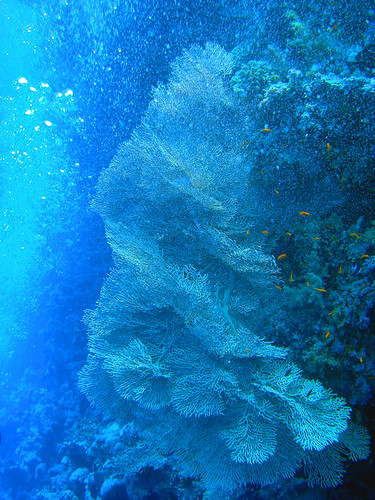
Shark Reef and Yolanda Reef are two reefs rising just off the Ras Mohammed coast. They are twin peaks of a single coral sea mount, separated from the mainland by a shallow channel.
Shark Reef is the more colourful and spectacular of the two reefs; with its wall and great marine life. Yolanda Reef is the larger of the two. Its name comes from a vessel which sank here in 1980.
Two ergs rise up from a vertical wall with a drop off down to 300 metres. The dive begins at shark reef and continues with the current until reaching the cargo of the Jolanda, where the sea floor rises to about 15-25 metres and is strewn with toilets. There are lots of schools of fish and other sea life including stone fish and scorpion fish. Large pelagics may gather beyond the reef, so keep watching the open sea.The water here is truly deep and as you look down the vertical wall the water takes on an inky dark feel, even though viz is often in excess of 30m. An ideal start depth here would be the 30-40m mark, where if the current allows it is worth spending some time looking out into the blue.
Whilst a little more rare these days it is still possible to see white-tip reef sharks and if you're lucky larger grey reef sharks identifiable by the thick black strip which runs all the way down the rear of their tail fins. Scalloped hammerhead have been spotted as well. Also look out for barracuda, jacks and tuna. The reef itself on the eastern side of Shark Reef is fed by nutrients from the sometimes strong currents and as a result there are some beautiful gorgonian fan corals and black whip coral. The deeper part of the reef has a proliferation of soft coral from the 30m - 70m range. Soft coral requires much less light than hard coral and seems to thrive in this inky abyss. Once you have spent some time on the east side of Shark Reef, or if the current is running, then turn and with your right shoulder reef side head southwest around the reef. You will see the reef wall sloping up beneath you as you head towards the gap between Shark Reef and Jolanda and you drift over a rising plateau.
Ras Mohammed is the National Park of South Sinai and located on the very tip of the Sinai Peninsula; it probably represents some of the most famous dive sites in the Red Sea with 800-metre (2,600 ft) deep reef walls and pounding current and coral gardens.
Giant Gorgonian, Shark Reef, Ras Mohammed, Egypt
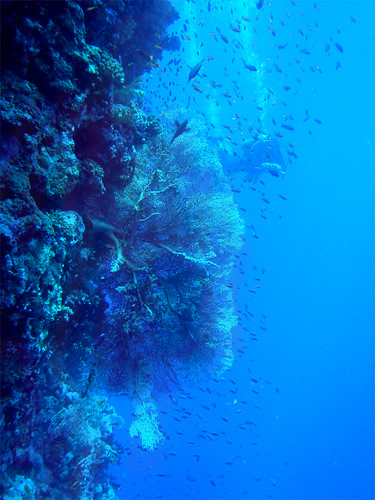
Shark Reef and Yolanda Reef are two reefs rising just off the Ras Mohammed coast. They are twin peaks of a single coral sea mount, separated from the mainland by a shallow channel.
Shark Reef is the more colourful and spectacular of the two reefs; with its wall and great marine life. Yolanda Reef is the larger of the two. Its name comes from a vessel which sank here in 1980.
Two ergs rise up from a vertical wall with a drop off down to 300 metres. The dive begins at shark reef and continues with the current until reaching the cargo of the Jolanda, where the sea floor rises to about 15-25 metres and is strewn with toilets. There are lots of schools of fish and other sea life including stone fish and scorpion fish. Large pelagics may gather beyond the reef, so keep watching the open sea.The water here is truly deep and as you look down the vertical wall the water takes on an inky dark feel, even though viz is often in excess of 30m. An ideal start depth here would be the 30-40m mark, where if the current allows it is worth spending some time looking out into the blue.
Whilst a little more rare these days it is still possible to see white-tip reef sharks and if you're lucky larger grey reef sharks identifiable by the thick black strip which runs all the way down the rear of their tail fins. Scalloped hammerhead have been spotted as well. Also look out for barracuda, jacks and tuna. The reef itself on the eastern side of Shark Reef is fed by nutrients from the sometimes strong currents and as a result there are some beautiful gorgonian fan corals and black whip coral. The deeper part of the reef has a proliferation of soft coral from the 30m - 70m range. Soft coral requires much less light than hard coral and seems to thrive in this inky abyss. Once you have spent some time on the east side of Shark Reef, or if the current is running, then turn and with your right shoulder reef side head southwest around the reef. You will see the reef wall sloping up beneath you as you head towards the gap between Shark Reef and Jolanda and you drift over a rising plateau.
Black Spotted Pufferfish, Shark Reef, Mohammed, Egypt
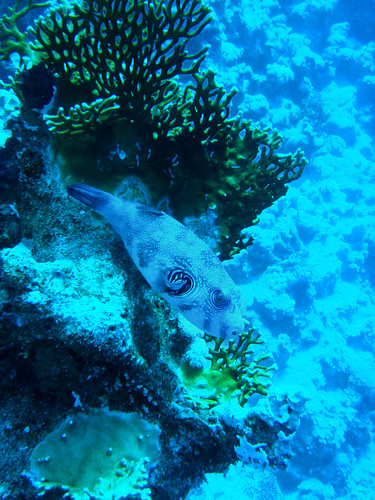
This Black-spotted puffer is very common sight in Ras Mohammad. This one is on the move, but these gentle, solitary fish may often be seen resting in a sponge or among coral branches. As with the other types of nearly 90 species of pufferfish, they inflate themselves by gulping down water when disturbed. Unlike the thick-skinned porcupinefish (also of family Tetradontidae, "fused teeth"), the Black-spotted puffer has relatively thin skin and small, short spines. This one is about seven inches in length. This species may vary from a gray base color to yellow. Pufferfish are also known as "blowfish" or "globefish".
Shark Reef and Yolanda Reef are two reefs rising just off the Ras Mohamed coast. They are twin peaks of a single coral sea mount, separated from the mainland by a shallow channel.
Shark Reef is the more colourful and spectacular of the two reefs; with its wall and great marine life. Yolanda Reef is the larger of the two. Its name comes from a vessel which sank here in 1980.
Ras Mohammed is the National Park of South Sinai and located on the very tip of the Sinai Peninsula; it probably represents some of the most famous dive sites in the Red Sea with 800-metre (2,600 ft) deep reef walls and pounding current and coral gardens.
Shark Observatory, Shark Reef, Mohammed, Egypt
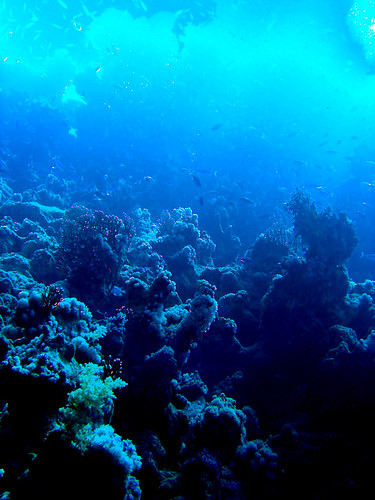
Shark Observatory
The site stretches from the foot of the observatory cliff in the north, across the mouth of a shallow box-shaped inlet, to the beginning of the Anemone City in the south. There are two possible shore entry points, one inside the inlet and the second in the small cove at the foot of the cliff. Both can be reached by road.
In the past, it was possible to see sharks here just by looking down from the cliff top but with the advent of dive tourism and its attendant boat traffic, the sharks have mostly moved on.
The site is a vertical wall, sloping outwards at its foot. The rugged profile is most dramatic in the northern section, where the reef face is especially contoured, with fissures, inlets and crevices to explore. Coral growth is good with lots of variety among both soft and stony species.
The steep profile does not encourage dense populations of smaller reef species, so quality and quantity of fish are somewhat dependent on currents and the pelagic life they encourage. Jacks, barracuda and the occasional gray or blacktip shark liven things up when the current is running: snapper, surgeons and unicorns are present in schools of varying size, and larger reef fish such as big grouper and Napoleons are usually on hand.
Divers should be careful of the strong currents which are common in this area and those who enter from shore should be doubly cautious. Once beyond the point to the north, there is no shore exit point. Do not round the point if current could prevent you from returning to the exit point.
Ras Mohammed is the National Park of South Sinai and located on the very tip of the Sinai Peninsula; it probably represents some of the most famous dive sites in the Red Sea with 800-metre (2,600 ft) deep reef walls and pounding current and coral gardens.
Shark Reef, Ras Mohammed, Egypt

Shark Reef and Yolanda Reef are two reefs rising just off the Ras Mohamed coast. They are twin peaks of a single coral sea mount, separated from the mainland by a shallow channel.
Shark Reef is the more colorful and spectacular of the two reefs; with its wall and great marine life. Yolanda Reef is the larger of the two. Its name comes from a vessel which sank here in 1980.
Sharm el-Sheikh has also become a favourite spot for scuba divers from around the world. Being situated near to the Red Sea, it provides some of the most stunning underwater scenery and warm water making this an ideal place to dive. Visitors to Sharm el-Sheikh can experience a variety of water and activities. Beach seekers find many activities such as diving, snorkeling, wind surfing, para-sailing, boating, and canoeing.
Ras Mohammed is the National Park of South Sinai and located on the very tip of the Sinai Peninsula; it probably represents some of the most famous dive sites in the Red Sea with 800-metre (2,600 ft) deep reef walls and pounding current and coral gardens.
By boat & from shore: Long boat time (> 30min)
average depth: 20.0 m
max depth: 50.0 m
visibility:Good ( 10 - 30 m)
dive type: Sharks &Reef
Red Sea, Ras Mohammad, Egypt
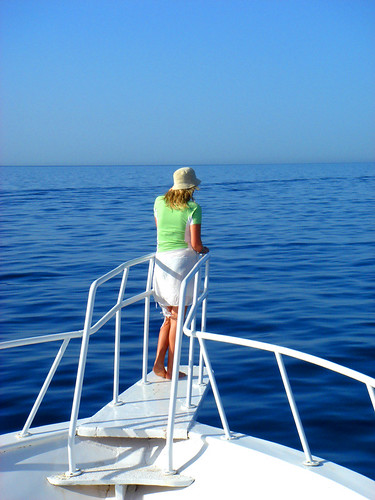
The Red Sea is a salt water inlet of the Indian Ocean between Africa and Asia. The connection to the ocean is in the south through the Bab el Mandeb sound and the Gulf of Aden. In the north are the Sinai Peninsula, the Gulf of Aqaba, and the Gulf of Suez (leading to the Suez Canal). The Red Sea is a Global 200 ecoregion. The Red Sea was also historically known as the Arabian Gulf, although recently Pan-Arabist nationalists sought to change the Persian Gulf's name to the Arabian Gulf.
Occupying a part of the Great Rift Valley, the Red Sea has a surface area of about 438,000 km² (169,100 square miles ). It is roughly 2250 km (1398 mi) long and, at its widest point at 355 km (220.6 miles) wide. It has a maximum depth of 2211 m (7254 ft) in the central median trench and an average depth of 490 m (1,608 feet ), but there are also extensive shallow shelves, noted for their marine life and corals. The sea is the habitat of over 1,000 invertebrate species and 200 soft and hard corals and is the world's northernmost tropical sea.
Ras Mohammad (Arabic: رأس محمد) is a national park located in Egypt at the southern extreme of the Sinai Peninsula, overlooking the Gulf of Suez on the west and the Gulf of Aqaba to the east.
Humphead wrasse, Shark Observatory, Ras Mohammad, Egypt
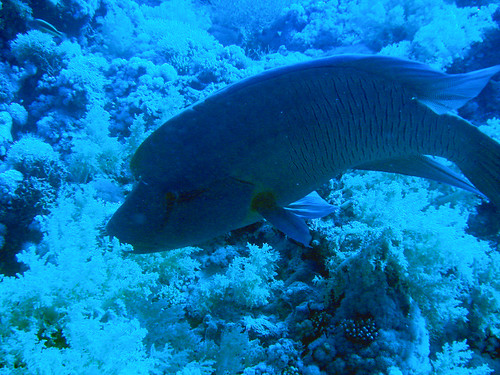
Humphead wrasse
The humphead wrasse (Cheilinus undulatus) is a wrasse that is mainly found in coral reefs in the Indo-Pacific region. It is also known as the Maori wrasse, Napoleon wrasse, Napoleonfish; or "So Mei" (Cantonese) and "Mameng" (Filipino).
The humphead wrasse is the largest living member of the family Labridae, with males reaching 6 feet (2 m) in length, while females rarely exceed about 3 feet (1 m). It has thick, fleshy lips and a hump that forms on its head above the eyes, becoming more prominent as the fish ages. Males range from a bright electric blue to green, a purplish blue, or a relatively dull blue/green. Juveniles and females are red-orange above, and red-orange to white below. Some males grow very large, with one unconfirmed report of a Humphead Wrasse that was 7.75 feet (2.29 m) long and weighed 420 lbs (190.5 kg).
Shark Observatory
The site stretches from the foot of the observatory cliff in the north, across the mouth of a shallow box-shaped inlet, to the beginning of the Anemone City in the south. There are two possible shore entry points, one inside the inlet and the second in the small cove at the foot of the cliff. Both can be reached by road.
In the past, it was possible to see sharks here just by looking down from the cliff top but with the advent of dive tourism and its attendant boat traffic, the sharks have mostly moved on.
The site is a vertical wall, sloping outwards at its foot. The rugged profile is most dramatic in the northern section, where the reef face is especially contoured, with fissures, inlets and crevices to explore. Coral growth is good with lots of variety among both soft and stony species.
The steep profile does not encourage dense populations of smaller reef species, so quality and quantity of fish are somewhat dependent on currents and the pelagic life they encourage. Jacks, barracuda and the occasional gray or blacktip shark liven things up when the current is running: snapper, surgeons and unicorns are present in schools of varying size, and larger reef fish such as big grouper and Napoleons are usually on hand.
Divers should be careful of the strong currents which are common in this area and those who enter from shore should be doubly cautious. Once beyond the point to the north, there is no shore exit point. Do not round the point if current could prevent you from returning to the exit point.
Ras Mohammed is the National Park of South Sinai and located on the very tip of the Sinai Peninsula; it probably represents some of the most famous dive sites in the Red Sea with 800-metre (2,600 ft) deep reef walls and pounding current and coral gardens.
Ras Mohammad Reserve, Egypt

Ras Mohammad (Arabic: رأس محمد) is a national park located in Egypt at the southern extreme of the Sinai Peninsula, overlooking the Gulf of Suez on the west and the Gulf of Aqaba to the east.
After the Six-Day War, in which Israel gained control of the Sinai Peninsula, Israel established the Ras Mohammad area as a protected area. When the Sinai Peninsula was returned to Egypt, Ras Mohammad lost protection from fishing and other human activities. Some of the fishing methods, such as use of dynamite, also were impacting the coral reef in addition to the fish populations. In the late 1970s, pressure mounted on Egyptian authorities to place Ras Mohammad under protection.
In 1983, the Egyptian Environmental Affairs Agency (EEAA) established the area as a marine reserve for the protection of marine and terrestrial wildlife. The park was also established to protect against sprawl from Sharm el-Sheikh and other coastal development.The name literally means "Muhammad's Head", where "head" in this instance means "headland". There is a saying in the area that the name arose because in side view the contour of the cliff looks like the profile of a bearded man's face, with horizontal hard strata providing the nose and bearded chin.
Unicorn fish, Shark Reef, Ras Mohammad, Egypt
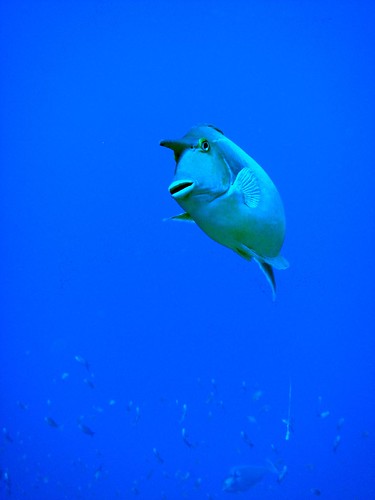
The unicorn fishes are 17 species of tropical marine surgeon fishes in the genus Naso. They are so named because of a spike that protrudes from its forehead; however some species have a bulbous protrusion rather than a pronounced spike, and some lack a spike altogether. Unicorn fishes usually have a pair of spines on each side of the tail shaft that are used for defence.
Shark Reef and Yolanda Reef are two reefs rising just off the Ras Mohammed coast. They are twin peaks of a single coral sea mount, separated from the mainland by a shallow channel.
Shark Reef is the more colorful and spectacular of the two reefs; with its wall and great marine life. Yolanda Reef is the larger of the two. Its name comes from a vessel which sank here in 1980.
Shark Reef, Ras Muhammad, Egypt
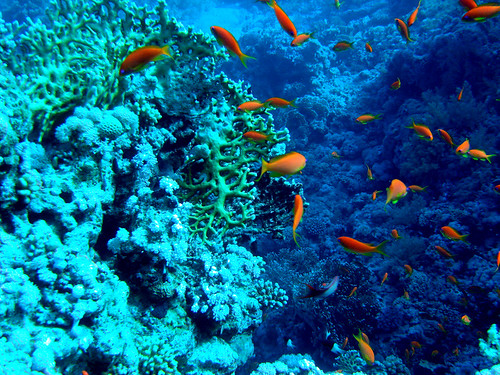
Shark Reef and Yolanda Reef are two reefs rising just off the Ras Mohammed coast. They are twin peaks of a single coral sea mount, separated from the mainland by a shallow channel.
Shark Reef is the more colorful and spectacular of the two reefs; with its wall and great marine life. Yolanda Reef is the larger of the two. Its name comes from a vessel which sank here in 1980.
Sharm el-Sheikh has also become a favourite spot for scuba divers from around the world. Being situated near to the Red Sea, it provides some of the most stunning underwater scenery and warm water making this an ideal place to dive. Visitors to Sharm el-Sheikh can experience a variety of water and activities. Beach seekers find many activities such as diving, snorkeling, wind surfing, para-sailing, boating, and canoeing.
Ras Mohammed is the National Park of South Sinai and located on the very tip of the Sinai Peninsula; it probably represents some of the most famous dive sites in the Red Sea with 800-metre (2,600 ft) deep reef walls and pounding current and coral gardens.
Subscribe to:
Posts (Atom)