Showing posts with label Thoughts. Show all posts

Friday, 1 January 2010

James Cameron speaks

The following is a transcript of a piece I did for http://scyfilove.com. A great Blog for everything Science Fiction related. Keep an eye on it. The original article can be found here!

IN a great guest blog, Scyfi Love’s man in London Craig Grobler – aka @ckc1ne on Twitter and a top bloke all around – tells of meeting up and spending three hours in the company of James Cameron ahead of the release of his latest blockbuster, Avatar.

In that time Cameron and Craig talked about the origins of his most famous creation, The Terminator, his hopes for Avatar and the technology behind it, the death of Stan Winston and what the future may hold.

Big thanks to Craig for what is a tremendously detailed and involving blog post, so sit back, relax, take the phone off the hook and read on …..

James Cameron in conversation
story-teller; (stawr-ee-tel-er) n.
- A storyteller is someone who tells or writes stories.
- One who relates anecdotes.


James Francis Cameron (born August 16, 1954) is a Canadian film director, producer, screenwriter and film inventor. His writing and directing work include The Terminator, Terminator 2: Judgment Day, Aliens and Titanic. To date, his directorial efforts have grossed approximately US$1.3 billion in North America (adjusted for inflation) and close to US$3.5 billion worldwide. After several feature films, Cameron turned his focus to documentary filmmaking and the co-development of the digital 3-D Fusion Camera System. He returned to feature filmmaking with the epic science fiction film Avatar, which made use of the Fusion Camera System technology.” – From Wiki

I HAVE been a fan of James Cameron since about 1985 when my mind was melted by The Terminator. At the time The Terminator was like nothing we had seen before – fresh, original and a budget that kept it edgy.

Mashing together science fiction memes, The Terminator tapped into man’s fear of technology by bending genres, clever raw visual effects and the merging of complex plot elements into a neat rollercoaster ride. I still rate it as one of my favourite films of all time; it’s one of those films that are so fresh it pulls the carpet out from everything that has gone before.


I had seen and enjoyed some of his previous works (at the time had little to no idea that he was involved) such as Roger Corman’s 1980 Battle Beyond the Stars, Kurt Russell’s outstanding 1981 Escape from New York, his directorial debut Piranha II: The Spawning, Galaxy of Terror and Android in 1982.

Since The Terminator, Cameron has gone on to conquer the world. I have enjoyed most of his recent works, but The Terminator will always epitomize James Cameron and science fiction for me.

Clearly the work of a man consumed by his passion, with little budget and a lot of talent the man created a genre, a cultural icon, a sci-fi phenomenon, groundbreaking special effects, a merchandising Empire, a cult following, a successful line of sequels (I didn’t say good), one of the most memorable quotes in cinema and careers for himself and his team.

All this from a screenplay he sold for $1 with the condition that he could direct it.

Love or just tolerate his films, I think it can be agreed that the world he creates on screen to support his tales are believable and immersive. He is a brilliant film all-rounder who loves what he does.

A lot is made about his love of technology and technical detail, but above all he is a master storyteller that creates a believable environment to enable his vision.

I admire James Cameron’s dedication to getting it right. I am also mildly obsessed with the process of creativity, specifically the process of story development from concept to screen.

So when the opportunity to meet Jim Cameron and hear him in conversation about his life in pictures came up I didn’t need to be asked twice.
What were James Cameron’s early influences?

Cameron was born near the Arctic Circle moving to Niagara Falls when he was about two, two and a half. His time in this location embedded a deep respect for nature and the outdoors.

This combined with the influence of his father, an engineer made him a bit of a science geek. Water, nature and man vs. nature are all constant themes throughout his films. As an aside, his love of the ocean became apparent, he has clocked 2,500 hours underwater, 500 of those hours in a submersible.

Early on he loved the works of film legend Ray Harryhausen (remember the stop motion in the climax of The Terminator?) this lead to “Whenever he saw something that made a strong impression on him he would draw it, as well as embellish it and create his own story around it.”

2001 was another trigger point for him; he would have been about 14/15 when he saw this. The slit scan scene inducing vertigo and causing him to wretch. He had seen nothing like 2001 before and created a desire to emulate technique. This was a direct influence on him making models and setting them up for filming with his dad’s camera. A friend had a still camera so they started experimenting with stop animation.

At this point I should mention (as you may be unaware) that James Cameron started his film career as a miniature model maker at Roger Corman Studios.

How was The Terminator born?
I had heard various versions of how The Terminator came about and was keen to hear in Cameron’s words how The Terminator unfolded.

James Cameron, in Craig's pictureDuring a stressful period editing Piranha II: The Spawning in Rome “he was having weird dreams of a chrome skeleton/ death image coming out of a fire, kind of like a Phoenix”. He sketched it and around this nucleus he created a story that included what it was, where it came from and who it was after. It all fell into place.

From this idea, when he got back to LA and was sleeping on a friend’s coach he talked an agent into representing him.

The agent’s response to his idea of a hit man from the future that comes back to kill a girl who is nobody in the present, but will be important in future events? “Terrible idea, don’t do it.”

He added: “The producers wanted me to talk to O.J. Simpson for the role of The Terminator and Arnold Schwarzenegger for the role of Kyle Reese. I didn’t want to cast either of them but didn’t feel comfortable blowing off the studio heads’ idea either.”

At the time he did not think that people would have believed a nice guy like OJ could be a ruthless killer. So he went to pick a fight with the relatively unknown Conan instead. Schwarzenegger was charming, passionate and loved the script. He was liked for the Kyle Reese part but the whole time Cameron was talking to him he was thinking he was perfect for The Terminator.

What has James Cameron been doing in the 12 years since the release of Titanic?
There is something very real, yet in a science fiction/fantasy kind of way, about exploring inner space. He always wanted to go to space which he wasn’t able to do, but he could go to the bottom of the ocean.

So he wound up working with the Russian submersibles on six deep ocean expeditions over a five-year period, making four documentary films in that time

He was having an amazing time and “perfecting” the 3D technique at the same time, shooting both Ghosts of The Abyss and Aliens of the Deep in 3D. He was also raising a family, which the kind of commitment he has when making a film would not have allowed him to do.

Avatar
I had been careful to avoid all written information about Avatar as I want to see it fresh and unencumbered with expectations on the 3D IMAX screen, as intended.

Sure, I was fortunate enough to see early previews on a regular digital 3D screen, the 3D IMAX screen and Hi Def Zune via Xbox in 2D.

As an aside I was surprised as I preferred the quality of screen movement of the BFI’s smaller 3D screen to the IMAX. I thought that the characters’ motion seemed to be a little clearer where as the IMAX’s version seemed a little blurred particularly on fast movement.

For the record I am a fan of the IMAX and believe that any film can be made better by screening it at the IMAX. If it’s in 3D at the IMAX it’s bound to be great. I’m hoping that this issue relates directly to the preview versions themselves rather than the BFI having better projection facilities.

But this post is not about Avatar, rather the road to Avatar.

Although unconfirmed – it does seem as if James Cameron wants to make a virtual reality film. Not a film about virtual reality but a film that immerses its audience in the film itself. I guess this the final atmospheric/environment barrier stopping an immersive audience experience. With Avatar he has almost achieved this.

Bearing that in mind Cameron has been supporter of the immersive experience/3D as early as 1996 when he created the T2 3-D: Battle Across Time ride for Universal Studios Theme parks ( a bad 2D copy of the show intro can be seen here).

In 2003 he mentioned in various interviews that he was “going to do everything in 3D now”.

With piracy on the rise, competition from the online world and the increase in quality of home entertainment systems, cinema visiting market share has been shrinking. Clearly he sees 3D as a great way “to reinvigorate “the spectacle of cinema”.
More on Avatar

Avatar started off as an idea as early as the mid 1970s. The story was written in 1995 as his dream project that he always wanted to do, a fantasy story taking place on another planet with cool creatures; it was intended as the ultimate creature movie.

The design alone was attractive enough for him to be involved, but the technologies required for photorealism were still years off.

So he went off and shot Titanic, and after Titanic his company was supposed to have all the answers as how to shoot Avatar.

Their response was that it wasn’t possible without a lot of money and time.

Cameron knew that computer graphics would get where they needed to be for Avatar to be created – it was just a question of when it would be.

When it looked like the CG was mature enough Cameron started shooting in 2005. It took Digital Domain two years to get the performance capture pipeline to where it needed to be, before starting to work with actors in 2007. Two major advances (there are more) that Cameron’s Avatar has brought us are:

Perfcap: The human body has 200+ muscles; over half of them are in the face.

A mistake that previous motion capture techniques had laboured under was capturing the movement of bodies but not being able to capture the key emotional touch point – the human face. The resultant dead eye effect mooted efforts.

So Cameron’s team invented a “facial image-based facial performance capture system” – in essence a head rig worn by the actor with a camera accurately photographing the detail of facial expressions in close-up, 100% of the time (including eye movement). Cameron coined the phrase “performance capture” as opposed to motion capture. Abbreviated: Perfcap, which works neatly as each Perfcap rig is individually modeled on the actor’s skull cap.

Simulcam: To truly understand Simulcam, one needs to know that Cameron’s team created a virtual world that was filmed from the inside. Imagine taking a camera into a 3D virtual environment like a game and making a film.

To be honest this is pretty much how regular 3D rendering works anyway, however the Simulcam system allows filmmakers to view a virtual scene (exotic jungle, strange planet, airship interior) in real time, while simultaneously viewing the actor’s virtual character in real time as they perform their scenes.

This is exciting stuff and may change the way films are made moving forward.

How has Stan Winston’s passing affected him personally & professionally?
When I asked this question, James Cameron was visibly touched and thanked me for asking it - This was actually Neil from http://scyfilove.com/'s question.

Stan Winston and James Cameron first worked on The Terminator together and had been friends ever since. They continued their relationship working on Aliens and Terminator 2 before forming Digital Domain and working on Titanic.

Cameron and Winston had a shared dream to create the most realistic characters and CG was a key to achieving this.

Winston had been struggling with cancer for some years and became very ill prior to the making of Avatar. When the first footage of Avatar had been completed, Winston was too ill to come around to see the results.

So Cameron loaded it onto his laptop and went over to his house, but unfortunately Winston was too ill to see anybody.

Winston died the next morning without seeing the result of what they set in motion with their shared dream of [realistic] CG characters.

“Stan’s company was integrally involved in the creation of the characters; they actually formed a new company called Legacy in Stan’s honour to carry on the legacy of everything he had created,” Cameron said. “His passing is a great loss because he would have stayed active and creating new creatures from his imagination for the next 20 years if he could.”

What are the next big challenges in filmmaking?
Well, earlier on talking about Avatar, Cameron said: “In terms of CG we have successfully created water, fire, smoke, creatures, musculature and faces and although the characters in Avatar are not strictly speaking human, they are driven by human actors, so the human emotional aspect has been created within the characters.

“We always figured that was the last hurdle or the Holy Grail of CG and we have done that now.

“There are a couple of little things we still need to work out, but it is sort of all there now as a vocabulary. We are only limited by what you can imagine, by what the artist can imagine, how they actors do the performance and the story you want to tell.

“[However] making Avatar we made a lot of mistakes, went down some blind alleys and meandered a bit and it took us a lot to work out exactly how to do everything. I think the next big challenge honestly is a process challenge.

“For me it is a challenge of being able to get the same end result as Avatar in less time, more efficiently for less money. And we’ll do that be carefully analyzing what we have done and cleaning up the process.”

When asked about the idea of real in relation to how realistic Pandora looks, e responded with the idea that real is meaningless now and the lines between CG and photography will continue to blur.

What will he be working on next?
I asked James Cameron point blank what he will be working on next, even throwing in how he had alluded to both the terms “Innerspace” and “Fantastic Voyage” during his talk.

His response was that he’ll be waiting for the dust to settle from Avatar before moving on and his lip are sealed.

Earlier on Cameron had spoken about how he lays his seeds deep and having them pay off later. He also said that he pitched the concept of Avatar to the studio with the idea that they were going to spend money on the first one, but on the second one we’ll be able to advertise that, and we can focus on the story and they went for it.

For Avatar Cameron’s team created a huge library of assets that can now be used at a much smaller cost, as the majority of the work has already been done.

It seems the sky is the limit, but ust where that sky is is still open to debate!

Final thoughts
In the three hours I was in James Cameron’s company – including a one on one chat – he came across as a passionate, insightful and affable storyteller with a contagious smile. Nothing like the ego driven megalomaniac that we have come to expect.

I think that the biggest surprise for me was the way he viewed Avatar’s release.

I may enjoy it, I may not – that remains to be seen. Either way I had assumed that Avatar was going to be a phenomenal success and possibly the biggest film ever made, etc, etc.

It did sound like although Cameron had put his best into it and had made his dream project the way he wanted to – he was aware that its success is not a certainty. He seemed genuinely relieved and pleased that early reviews had been positive.

I’m really glad that I finally met one of my heroes. His passion for storytelling may not have diminished and each of his projects may be a huge challenge, but too be honest, I would have loved to have met Jim Cameron 25 years ago when he was less established, full of fire and working on smaller less polished creative projects. I guess cream will always rise to the top though.

And now I’m off to watch The Terminator again!

Neil from http://scyfilove.com has correctly pointed out that:

“When it looked like the CG was mature enough Cameron started shooting in 2005. It took Digital Domain two years to get the performance capture pipeline to where it needed to be, before starting to work with actors in 2007.”

For the record, following TITANIC, Jim worked with his own team — not Digital Domain — on the AVATAR project. Jim sold his interest in Digital Domain in 2006, and is no longer associated with the company.

Sunday, 18 October 2009

Sam Rockwell, MOON, Great Performance, Oscar? I'm just saying. Spread the word.

A case study in making things happen. Many believe that Sam Rockwell's performance in sleeper hit MOON deserves an Oscar nod. Below Duncan Jones director of the Moon takes this belief one step further and chats with LAGenX.


Something that Duncan Jones doesn't mention that is if you
want to see more great inventive film making like MOON.
These guys need our support. Spread the word!

More info & deets on getting involved can be found on Duncan Jones' blog here!

Sunday, 2 August 2009

Terry Gilliam Retrospective at the BFI

When Terry Gilliam’s Tideland was awarded the FIPRESCI prize at Spain’s 2005 San Sebastian Festival, jurist Sergi Sánchez noted, ‘Gilliam’s was the only film that dared to propose a risky and radical image, without any concessions, on a specific matter: madness as the only way of escaping in the face of a hostile environment. All this is endlessly coherent with the director’s body of work, which has been frequently misunderstood by the critics, the industry, and audiences alike.’ The BFI reflects on just how Gilliam’s own brand of cinematic ‘madness’ has cast him as a true maverick, perhaps even caught on the cusp of genius, as they mount a comprehensive retrospective.


Born in Minnesota in 1940, Gilliam moved with his family to LA where he was brought up and, for a while, tried his hand as a (struggling) cartoonist. His chagrin at the US invasion of Vietnam was a catalyst for his move to England where he re-invented himself as an ‘animator’. Gilliam would often provide snippets of work for the BBC, which led to his meeting with the Monty Python team and the beginnings of his career as an imaginative and highly inventive director. In his first feature, Monty Python and The Holy Grail (1975), he and fellow director Terry Jones managed to transform the lack of money for hiring horses into a joke (coconut sound-effects accompaniment to knights miming riding) fondly remembered even now. This was followed by the medieval fantasy Jabberwocky (1977) and the smash-hit Time Bandits (1981). Then came his Kafkaesque feature Brazil (1985), starring Jonathan Pryce and Robert De Niro, which has become a cult classic.

In the years that followed, Gilliam declined the opportunities to direct blockbusters such as Who Framed Roger Rabbit and Forrest Gump, amongst others. He suffered battles with studios, abandoned projects and outrageous bad fortune – including, most recently, the death of one of his lead actors, Heath Ledger. Despite this he has managed to persevere and deliver truly individual curiosities in a field often dominated by bland and predictable fare and has always been able to turn a drawback into an advantage in his cinematic world that’s part fairy tale, part Hieronymus Bosch, but all Gilliam, and populated by a strange but oddly compatible group of fellow eccentrics. Whether he’s following The Adventures of Baron Munchausen (1988), The Fisher King (1991) or The Brothers Grimm (2005), his films can electrify audiences. Gilliam has never trod an easy route, his career path more obstacle race than 100-metre dash, but the results glitter with ambition and glorious imagination.

Wednesday, 18 February 2009

Devil in the White City - Fan Made Trailer

Devil in the White City is a book by Erik Larson that tells the story of 2 men "Their fates were linked by the magical Chicago World’s Fair of 1893, nicknamed the “White City” for its majestic beauty. Architect Daniel Burnham built it; serial killer Dr. H. H. Holmes used it to lure victims to his World’s Fair Hotel, designed for murder. Both men left behind them a powerful legacy, one of brilliance and energy, the other of sorrow and darkness." This is an awesome tale weaving 2 stories together. The mast incredible thing about the story is that it is all true.

This story is ripe to be made into a film. I recently asked David Fincher if he had any intrest in adapting it his response was brief and to the point "I would need to see a screenplay". For more info visit here: http://www.randomhouse.com/crown/devilinthewhitecity/home.html


I hope to see this on the big screen soon.

Tuesday, 20 January 2009

A cinematic timeline of the road to the Obama

A cinematic timeline of the road to the Obama

1967: Det. Virgil Tibbs - In the Heat of the Night

After a wealthy northern factory owner is murdered, racist Mississippi cops accuse African American Virgil Tibbs (Sidney Poitier) of the crime. Once they learn that he is a renowned Philadelphia homicide detective, they reluctantly seek his help. As Tibbs displays his skills as a detective, he begins to win the respect, protection, and ultimately friendship of the Police Chief Bill Gillepsie (Rod Steiger).

1972: President Douglass Dilman - The Man

When the President and Speaker of the House are killed in a building collapse, and the Vice-President declines the office due to age and ill-health, Senate President pro tempore Douglas Dilman (James Earl Jones) suddenly becomes the first black man to occupy the Oval Office. The events from that day to the next election when he must decide if he will actually run challenge his skills as a politician and leader.

1991: Assistant District Attorney - Ricochet

Rookie Los Angeles cop Nick Styles is at a Los Angeles street fair, where hit man Earl Talbot Blake pulls a double cross on some drug dealers, killing four men. Nick Styles apprehends the hit man. Over the next few years, Nick's career takes off: he's offered a job in the district attorney's office, and his hip media style keeps him in the public eye. Blak orchestrates an escape from prison and sets about ruining Nick's life. Nick is forced to turn to his childhood friend, gang leader Odessa, for help in clearing his name and stopping Blake once and for all.

1998: President Tom Beck - Deep Impact

A teenage astronomer and his teacher discover an object amongst the stars at night. Little do they know that it's a comet on a direct collision course for earth. After the teacher dies in a car crash trying to report his findings the President announces the comet's existence. He also states that there is no need to panic, because NASA is going to send astronauts on the space mission, Messiah. Their mission is to destroy the comet before it gets too close to the earth. When Messiah backfires, the President announces that special caves will have to be built, and the government will have to have a lottery-of-fate to randomly select 800,000 ordinary American citizens to go along with 200,000 scientists, soldiers, and other officials. These 1,000,000 people will be set aside to save the population from extinction when the comet hits.

2003: President Mays Gilliam - Head of State

Mays Gilliam, a Washington D.C. neighborhood Alderman, is about to be red-lined out of his job. But after the untimely death of the party frontrunner, Gilliam is plucked from obscurity, and thrust into the limelight as his party's nominee--for President of the United States. The players in Gilliam's life include: Mitch Gilliam, his unsophisticated older brother who becomes his running mate; Kim, his ex-girlfriend who had once dumped him, but who now has a sudden change of heart as she sees a chance at becoming First Lady; Martin Geller, his campaign manager; Lisa Clark, the woman who truly believes in Gilliam; and Debra Lassiter, the woman who doesn't have faith in his candidacy, and is serving as his reluctant advisor.

2003: President David Palmer - 24


David Palmer, J.D. is a fictional President of the United States played by Dennis Haysbert as part of the television series, 24. Palmer served as the show's second-most prominent protagonist, after Jack Bauer. Throughout the series, Palmer's ex-wife Sherry and brother Wayne are both key figures in his administration. He has two children: a son, Keith, and a daughter, Nicole. Palmer is a member of the Democratic Party.


2006: President Wayne Palmer - 24


The brother of former President David Palmer, Wayne came in to replace Mike Novick as the President's Chief of Staff, after Palmer had relieved Novick of his duties at the end of Season Two. He is a veteran Marine. He also has a sister named Sandra Palmer. After high school, he received a baseball scholarship to Stanford University, where he was a pitcher and graduated with a Bachelor of Arts in Political Science. He went on to receive his Juris Doctor from Yale Law School. It is presumed that, like his brother, Wayne Palmer is a Democrat.
Before being employed by the President, Palmer was a member of the United States Marine Corps, though he did not see combat. At some point after being discharged, Palmer worked as an Attorney at Law for Anderson & Siebertz for a period of time. Afterwards, he served as a COO for Milliken Enterprises that was owned by Alan Milliken, a high powered businessman backer of his brother. While Milliken was hospitalized, recovering from a stroke, Wayne embarked upon an affair with Milliken's wife, Julia.

Tuesday, 6 January 2009

The Wrestler a film by Darren Aronofsky starring Mickey Rourke Part 2

Continuing my discussion of The Wrestler and a chance to chat to Mickey Rourke.

Mon 5 December 2008, early evening Leicester Square, London. The producers opted for a low key UK premiere for The Wrestler with a celebrity audience as well as Mickey Rourke in attendance. Meanwhile just around the corner at the Curzon Soho an intimate audience of around 250 people gathered at the Curzon Soho to view a special preview of The Wrestler and participate in a Q&A session with the film's leading man Mickey Rourke.


I was keen to gain some insight into the man I had held in a revere, pertinent questions such as; how did he feel about his career in light of the buzz around The Wrestler? Did he dig deeper for this role than others? Did he have to undergo any physical conditioning (apart from wrestling training) for the role? Did he contribute to the storyline (and location choices)? What's next for Mickey Rourke? What was the latest with Sin City 2? Would Marv be back?


Rourke has clearly been left burned and disillusioned by the politics behind Hollywood. But after hitting rock bottom "living on fumes", he is trying to change what "he did not understand needed to be changed". Up until the post production process of The Wrestler he was unaware of his next steps or what his next job might be. He is grateful for the kudos received for the Wrestler and is hopeful for the future. In spite of his his troubles Rourke is still very much his own person.


He really wanted to work with Aranofsky and had developed a bond after Aranofsky put his backing behind Rourke for the role. Although Aranofsky set the
bar high for cast, Rourke strived to bring the character of Randy 'The Ram' Robinson to life as much to apply his craft as to meet Aranofsky's expectations.

His training regime allowed him to gain 34 pounds of muscle for the role. In the film he looks every bit the professional Wrestler. He underwent Wrestling training intense enough to shift him from thinking that Wrestling was on par with pantomime to respect for the sport and the sportsmen that participate in it. He sustained several serious injuries while filming.

Rourke's next projects include:
A remake of "13 Tzameti" directed by the Géla Babluani who wrote and directed the original.

My initial thoughts on seeing 13 were: Mind blowing little film that will keep you on the edge of your seat. Has all the trademarks of a first time film school production (lighting, black & white, metaphors, etc.) but all comes together in a gritty tale. Hopefully the remake starrring; Jason Statham, Ray Liotta, Ray Winstone, and 50 Cent will stay true to its roots.


Twenty-two-year-old Sebastien leads an impoverished life with his immigrant family constantly struggling to support them. While repairing the roof of a neighbor's house, he overhears a conversation about an expected package which promises to make the household rich.

Sensing the opportunity of a lifetime, Sebastien intercepts the package which contains a series of specific instructions. Following the clues, he assumes a false identity and manages to slip through the grasp of the enclosing police as he ventures deeper and deeper into the countryside. The closer he gets to his destination and the more people he meets along the way, the less he understands about what he is looking for. Ultimately, he comes face to face with a ring of clandestine gamblers placing bets on the outcome of a multi-player, high stakes tournament of Russian roulette. Directed by newcomer Gela Babluani, "13 Tzameti" (pronounced: 'zah-meti') is a winner-takes-all thriller, where an unfortunate young man is transformed into contestant #13 with no way out save his luck.

He is also in Bret Easton Ellis's The Informers and Elmore Leonard's much delayed Killshot which will also be released in 2009. He is also rumoured to be in Stallone's "The Expendables" and cast as "Whiplash" a villain in Iron Man 2.

In private discussion he was tight lipped about Marv's possible return in Sin City 2. I did not found out what the significance of the fun fairs was or if there was indeed any. Hopefully Mickey's talent will be recognised and his path ahead is less bumpy than the one behind him.

The Wrestler opens in the UK on January 16th.

Monday, 5 January 2009

The Wrestler a film by Darren Aronofsky starring Mickey Rourke Part 1

Something's burning white hot in freezing London tonight and it's Mickey Rourke's seethingly intense performance. Part 1

Mon 5 December, early evening Leicester Square, London. The producers opted for a low key UK premiere for The Wrestler with a celebrity audience as well as Mickey Rourke in attendance. Meanwhile just around the corner at the Curzon Soho an intimate audience of around 250 people gathered at the Curzon Soho to view a special preview of The Wrestler and participate in a Q&A session with the film's leading man Mickey Rourke.


The Players
Darren Aronofsky 39 year old film director. Lauded as the second coming with his debut feature film Pi (1998), critical acclaim continued with the bleak Requiem For A Dream. In 2006 finally opinions divided with The Fountain. The 2006 Hugh Jackman starring mind melting /time travelling /sci fi feature also starred Aranofsky's wife Rachel Weiszs and was seen as self indulgent by many.

Aronofsky has followed up the high concept Fountain with a pared down, back to basics, handy-cam shot story of a man past his prime. So far the The Wrestler has won critical acclaim, been nominated for countless awards, garnered a Golden Lion at the Venice Film Festival and there has been much talk of Mickey Rourke deserving an Oscar for his performance.

Aronofsky's films are studies into the human condition - Pi (Paranoia & technophobia), Requiem for a Dream (old age, drug dependency & lust), The Fountain (Loss of a loved one). He tends to explore the issues that are part of life but ignored by any filmmaker that wants a paying audience to view their films. With The Wrestler Aronofsky explores the world of an ageing professional athlete; his post prime career, his relationships and socio environment. Think more Requiem For A Dream than The Fountain.

To carry both the gruelling physical and mental weight of the leading role, Aronofsky called on the man whose own career could have easily been the blueprint for The Wrestler had he taken a different path. Allthough Aranofsky's choice, Rourke's casting was not a sure thing as Nicholas Cage almost sealed the deal at one stage.

Phillip Andre Rourke Jr. aka Mickey Rourke aka. Sir Eddie Cook aka 'Boogie', Marv, Harry Angel, Harley Davidson, The Pope or Motorcycle Boy started off as a boxer before embarking on a promising film career.
Rourke studied method acting at the Lee Strasberg Institute under Sandra Seacat. In 29 years he has built an impressive resume with some standout performances. He has worked with some greats including Spielburg, Michael Cimino, William Hurt, Levinson, Ford Coppola, Alan Parker, Robert De Niro, Gene Hackman, Nicolas Roeg, Faye Dunaway, Barbet Schroeder, Bob Hoskins, Christopher Walken, Steven Sean Penn and Jack Nicholson.

Somewhere in the early 90s Rourke's hell-raising lifestyle overshadowed his talent and he was blacklisted by Hollywood. Rourke started producing films from material he had written but ultimately he was forced him to take some questionable roles as he says "to pay for his lifestyle". "The 90s were bad!"

Even in the most dire of productions Rourke's performance does not falter, sometimes misguided and out of place - he has remained his own man and true to ensuring his performances are solid. Somwhere in the early 2000s Rourke rebooted his career he started taking on small roles in rated films a handful of loyal friends keeping involved in bigger projects such as Stallone's Get Carter, Robert Rodriguez's Once upon a time in Mexico & Sin City and Tony Scott's Domino & Man on Fire.

The Wrestler has many similarities to Rourke's own life but more to his self penned 1988 offering Homeboy. In this little known classic Rourke plays a ageing past his prime boxer that never quite lived up to his promise.

Even one of Rourke's favourite settings a Fun Fair features in one of The Wrestler's most bittersweet scenes. Fun Fairs at Coney Island were used in Angel Heart, 9 1/2 Weeks and Bullet - a film that Rourke wrote and produced. The Wrestler and Homeboy had scenes shot at Asbury Park.

Aronofsky's low fidelity visuals, sometimes barren soundtrack combined with quality performances from the cast that includes Marisa Tomei and Evan Rachel Wood and Rourke's gritty performance compliment the stark subject matter to create a crescendo of angst that will have you cringing, smiling and possibly bringing some strong emotions to the fore. Rourke's performance will possibly overshadow the rest of the cast, but mention should be made of the braveness of Oscar winner Marisa Tomei's performance and role.

As favours to Mickey Rourke both Guns n Roses and Bruce Springsteen contributed to the films soundtrack at minimal cost. Their music sets the tone for scenes in which they bleed into.

The Wrestler opens in the UK on January 16th.

Monday, 29 September 2008

Don Logan for Live Aid

Awesome I had heard about these promo videos that Ben Kingsley had done for Live Aid. I searched high & low for them for well over 18 months and eventually gave up writing them off to some sort of urban myth or marketing hype. Lo & behold if the possible visit from a friend sparks off a quick look for Don Logan media Hey Presto! Not 1 but all 3 of them.


For those of you who are not aware of who Don Logan is. Firstly shame on you - you are missing out on a modern classic. Rush out and get a copy of Sexy Beast as quick as possible.

Sexy Beast is a 2000 British film directed by Jonathan Glazer, starring Ray Winstone, Ben Kingsley and Ian McShane. It was Glazer's debut feature film. He had previously been a director of music videos, such as Rabbit in Your Headlights for British electronica group UNKLE, and commercials for companies such as Guinness and Levi.

It is a classic piece of modern gangster noir by way of MTV. An engaging story, colourful characters, music and vision working as one and there is Don Logan. Don is possibly the most menacing character since Sonny Corleone. Ben kingsley received countless nominations and awards for the role.

From Wiki:
Ben Kingsley as Don Logan. Don is a foul-mouthed, psychopathic and violent man who is part of the London underworld. He is a recruiter who puts crack teams together to do various jobs. A very determined man who will go to any length to make things go his way, Don uses anything and everything in his power to convince Gal to return to London to do a final job. Ben Kingsley, on the DVD commentry, calls Don "The Unhappiest Man in the World" and in several interviews, Kingsley has claimed that he based the character of Don Logan largely on his grandmother, whom he called, " A vile and extremely unpleasant woman."

Saturday, 29 September 2007

Being Michael Madsen Premiere with cast in attendance


I just saw "Being Michael Madsen" at its World Premier at the Raindance Film Festival in London - Madsen gives further straight talk on Inglorious Bastards & you heard it here first - "The Philistine" cometh.

After the screening the cast & crew attended & did a short Q&A afterwards. This is Bold & Ballsy independent film making. The film touches on many themes of celebrity culture whilst being engaging enough to keep you entertained (tongue firmly in cheek).

I'm not entirely sure how to define the film itself e.g. film within a film, contemporary Fellini on a shoe string (think La Dolce Vita), reality film, pseudo documentary - its all in there with a heavy dash of satire.

It is a lot of work but the performances from the cast are rock solid. This is a complete departure from Michael Madsen's usual hit or miss fare. It really shows many facets of the man beyond his Quentin Tarantino screen persona. I hope he gets some decent roles soon that do not involve throwing Segal out of windows :-). On the whole an enjoyable coaster ride but you do have to do some work - this is not just eye candy.

If I had to crit: The final scene (not the climax) may be a little weak - in the context of viewing it at the Raindance Film Festival with the cast & crew doing a Q & A afterwards it was awesome. However I suspect for anyone not watching the film with the live accompaniment may not be swept away by the final scene.


Standout performances by Virginia Madsen, Jason Alan Smith, Doug Tompos, Davis Mikaels & Kathy Searle. Harry Dean Stanton is hilarious.

I had the opportunity to ask the director Michael Mongillo what was next? To paraphrase he said he was keen on doing some action films and that his graphic novel "The Philistine" would be interesting to see on the screen. Now I had not heard of The Philistine previously but after a little net rummage discovered that The The Philistine is a highly rated graphic novel. With similar elements to Batman & The Punisher. After seeing Being Michael Madsen I can't wait to see Mongillo translate a clever caped crusader film to screen.

Naturally I asked Madsen about Inglorious Bastards, (which is listed on IMDB as having production kicked off in 2008). He played in coyly saying something to the effect that it's all in Quentin Tarantino's head/hands at this stage. He also mentioned that Tarantino was meant to be at the Premiere but was in Manila for a Death Proof screening.

Seriously cant you see Madsen in greens with one of those GI helmets (tilted to the side), holding a rifle in one hand and about to throw a pineapple grenade with the other - from behind a bunker while protecting his company?

Friday, 13 April 2007

Foosball at Cafe Kick


Foosball at Cafe Kick, originally uploaded by Craig Grobler.

I took this pic at Bar Kick, Shoreditch. Ben is off to Canada so farewell drinks were held at the popular foosball venue.

Foosball is the American corruption of fussball (pronounced the same), the German word for soccer-literally foot plus ball. While the sport has the more formal name of table soccer, to the American players who love it, it's foosball, or just foos.

Unfortunately, the origins of the game are not as easy to trace as those of its name. Like many games, it is quite possible that variations of foosball developed in different countries over roughly the same time period. Since organized soccer first entered the sports scene in the 1860s, the invention of soccer's table version can be safely dated sometime afterward, probably in the late 1800s. The earliest United States patent for a foosball table was registered in 1901, but it is generally agreed that foosball, like soccer, originated in western Europe.

I should say that the low quality of the pic is due to the use of my low res camera phone during a power failure.

Sunday, 25 March 2007

Looking back


040407, originally uploaded by Craig Grobler.

This pic was taken at a team get together at Keston Lodge, Upper Street - March 2005. It did not seem that long ago. I found out today that I'm shortly to be the last remaining original team member. I was first in and certainly did not expect to be around past my original colleagues.

Anyway here’s to you Lisa, Adam and Vic. Hope that you go from strength to strength.

Sunday, 12 November 2006

Val Kilmer & what happened? With some Richard Stanley thrown in

OK!! So my pal Mart & I were chatting about Val Kilmer (I had just watched Tombstone) and Doc "I'm here Huckleberry" Haliday deserved a mention. Kilmer seemed to have the world at his feet sky rocketing career, buckets of talent and the golden touch. What went wrong you may ask yourself?

He brought some great characters to life:

Nick “my father thought of it while shaving” Rivers - Top Secret (I was 14)
The Iceman - Top Gun (I was 16)
Madmartigan - Willow (OK I wasn’t a big fan of this one, but worth a mention)
Jim Morrison - The Doors (as a period piece, pretty good)
Doc Holliday - Tombstone (awesome)
Chris Shiherlis - Heat (acting for a change)
Entourage - The Sherpa (Episode 05, Season 01)

Yea I think that's it. Pretty much everything else he did was crap &
got exponentially worse. 3 unsubstantiated stories I can repeat - to add to the "Kilmer is difficult and brings it on himself" are:

I should mention that these stories are hearsay & never been proven in a court of law.

1. Circa 1980 - Apparently Kilmer & Kevin Spacey were amigos before either made it big. Val is set to go to Juilliard and become an ACKTor. He convinces the penniless Spacey to do the same. So spacey borrows the tuition fees from Kilmer's father. Spacey never repays the loan. This causes a rift between the 2 friends that continues to this day.

Side note: Up until 2002 Kilmer was the youngest student ever accepted into Juilliard's Drama department.

2. Circa 1986 - Val is up for a career making role as Kyle Reese the hero in an edgy sci-fi film called the Terminator. For some reason Arnult nixes the idea and squashes Val's chances. Ironically Arnult was the first choice for Kyle Reese, but when Cameron meets him, he decides he is more Terminator material.

The role eventually goes to Michael Biehn who does a great job anyway. Ironically Kilmer's Doc Holliday faced off against Biehn’s Johnny Ringo in Tombstone

This comes back to haunt Arnult years later when he is put forward
for the role of Mr. Freeze in "Batman 93 - Mo bat crap". Naturally being an ego less artist Val kicks up a fuss. The ensuing conversation
must have gone something like this:

Val: "I don't think so. Listen Mr Producer only one of us is going to
be in this film. So it's either Arnult or me. Need I remind I am the
greatest actor of my generation and you'll remember me from such films
as Afterschool Special: One Too Many, Spartan, Red Planet, Batman Forever and Alexander."

Producer:"PA get me Clooney on the phone & Val Don't slam the door too hard on your way out.

3. Circa 1995 - Kilmer career is bottoming out but gets the chance to act in a contemporary version of "The Island of Dr. Moreau" with Marlon Brando. By now Kilmer is a few roles away from Van Damme/Lundgren/Rourke status. However the producers clearly happy to have Kilmer on board and buckle to his ongoing demands including swapping from the lead hero to the Doctors sidekick.

Richard Stanley the skilled but relatively unknown director is continually at odds with Kilmer. After making a couple of low budget sci-fi/horror films including; "Hardware aka M.A.R.K. 13 & "Dust Devil". The underrated South African gets:
- a break that could make him
- gets a decent budget to play with
- gets to direct a classic story
- gets to work with Marlon Brando
- gets to work with Val Kilmer

However ongoing clashes between Kilmer & Stanley continue. Eventually Kilmer gets Stanley replaced by Frankenheimer. Putting Stanley’s career on hold again. Ironically by the end of filming Frankenheimer vows never to work with Kilmer again.

In a bizarre move Stanley hides out on the island set, gets disguised as one of the "mutated" extras and continues to be part of the film. Seriously who can blame the guy for not letting go of his dream?

Yea!! I'm rooting for the guy he's talented and will eventually break Hollywood. Just watch "Hardware aka M.A.R.K. 13" his first big effort. The screenplay was written by Kevin O'Neill (comic legend).

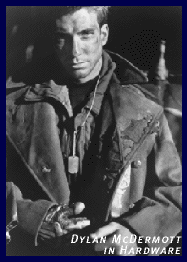
Although a low budget, the film exudes imagination, skill & talent. C'mon Iggy Pop as the DJ voice of Angry Bob. The destined for eventual greatness Dylan McDermott is the protagonist in this tale of a dystopian future.

Richard Stanley is coming back to Montreal. Last year he presented Dust Devil, this year he brings us his director's cut of the 1990 film Hardware, one of the few good cyberpunk films. A hallucinatory, drug-fuelled blend of Terminator, Mad Max and Blade Runner (with a cameo by Motörhead's Lemmy Kilmeister!), Hardware suffered at the hands of those shadowy studio types who always manage to fuck things up for creative and ground-breaking filmmakers. - montrealmirror


OK so on balance Kilmer's ego seems to be writing cheques his talent can't cash.

Friday, 10 November 2006

The quick and definitive history of Blade Runner

Early in the 21st Century, THE TYRELL CORPORATION advanced Robot evolution into the NEXUS phase -- a being virtually identical to a human -- known as a replicant। The NEXUS 6 Replicants were superior in strength and agility, and at least equal in intelligence, to the genetic engineers who created them. Replicants were used Off-world as slave labor, in the hazardous exploration and colonization of other planets. After a bloody mutiny by a NEXUS 6 combat team in an Off-world colony, Replicants were declared illegal on earth -- under penalty of death. Special police squads -- BLADE RUNNER UNITS -- had orders to shoot to kill, upon detection, any trespassing Replicants.

This was not called execution. It was called retirement.

LOS ANGELES
NOVEMBER, 2019
OK!! the other day I got into a discussion with a friend, lets call him Alex about the new release of Blade Runner he was under the impression that a version had just been released. We have had a running discussion about BR over the last 4 years. I'm a big fan and he doesn't understand what more there is to see, say or know about BR. I should mention that Alex actually owns a copy of "Future Noir: The Making of Blade Runner" by Paul M. Sammon as well as has a recorded from TV version of "On the Edge of 'Blade Runner' ". Both of which he loaned to me awhile back. Alex doth protest too much, methinks.

Anyhoo!! I thought I'd create the definitive list of the visual & soundtrack versions of the film that exists. I have steered clear of the content of Blade Runner for now. Allthough the following timeline is in chronological order I have indented the timeline where it was reto fitted.

1927 - German expressionist Fritz Lang creates Metropolis which feeds Ridley Scotts vision
1942 - Edward Hopper paints Nighthawks again this feeds Scotts bleek vision. Building on the dark atmosphere created by the death of Scott's just before the making of Blade Runner
1968 - Philip K. Dick writes "Do Androids Dream of Electric Sheep?". This forms the backbone of Blade Runner. Martin Scorsese and Jay Cocks were both interested but they don't option it.
1973 - Herb Jaffe options
1973 - Robert Jaffe does a screenplay
1975 or 76 - Dan O'Bannon and Moebius give us the conceptual visual stylings from their "The Long Tomorrow" graphic novel.
1975-77 - Hampton Fancher gets involved. Failing to option William Burroughs’ Naked Lunch. Brian Kelly & Hampton Fancher finalise a deal.
1979 - Alan E. Nourse gives us the title Blade Runner from one of his books about smugglers of medical supplies.
1979 - William S. Burroughs writes "Blade Runner, a movie" loosely based on Nourse's story. Only the title was kept for the film.
1979 - Hampton Fancher completes his screenplay for Blade Runner called "Android" later changed to "Dangerous Days".
1980 - David Peoples rewrites it
March 9, 1981 - Photography starts
June 25, 1982 - Blade Runner is released

Thank you http://scribble.com for the following detail of each print.

1982 - US Denver/Dallas Sneak Preview/Workprint
1982 - US San Diego Sneak Preview
1982 - US Theatrical Release
1982 - European Theatrical and Laserdisc Release
1992 - Blade Runner The Director's Cut
2006 - Restored and remastered DVD version of the 1992 Director’s Cut
2007 - Blade Runner: The Final Cut
Cable TV Version
Video Version

US Denver/Dallas Sneak Preview/Workprint--70mm (113 min):
- Webster's 2012 definition of a replicant used in lieu of opening crawl
- voiceovers deleted except at Batty's death
- Bryant says TWO replicants were fried running through an electric field
- conversation between snake-maker and Deckard is different and matches their lips
- includes shot of nearly nude dancers in hockey masks outside Taffey's bar
- Batty says, "I want more life, father."
- Pris lifts Deckard up by his nostrils when she beats him up
- different voiceover used after Batty's death
- ends with the elevator doors closing
- shorter than other versions

This version was shown at the Fairfax Theater in 1990 and UCLA's Los Angeles Perspectives multimedia festival in 1991. This was also the print shown at a London sneak preview in March of 1982. A 35mm reduction of this version was later shown at the Nuart and Castro Theaters in 1991. There were rumours that THIS version was the original director's cut, but the official 1992 Director's Cut is not the same.

US San Diego Sneak Preview (115 min):
- shows Batty making a telephone call to see if Chew is there
- shows Deckard reloading his weapon after firing at Batty
- Deckard and Rachael ride into the sunset

[Source: Video Watchdog no. 20, November-December 1993.]

European Theatrical Release/Criterion Laserdisc/Videocassette (117 min):
- Batty sticks his thumbs in Tyrell's eyes, which bleed copiously.
- Pris lifts Deckard up by his nostrils when she beats him up.
- Deckard shoots Pris a third time.
- more of Pris kicking and screaming when she is shot by Deckard.
- shows Roy actually pushing the nail through his hand
- Deckard and Rachael ride into the sunset

The added violence makes this version about 15 seconds longer than the US theatrical release. The 10th Anniversary video edition is the same as this release.

The Director's Cut (BRDC) (117 min):
- voice-overs completely eliminated
- added dialog from blimp to cover missing voice-over while Deckard waits for a seat at the noodle bar.
- 12-second unicorn scene added when Deckard plays the piano
- happy ending deleted (movie ends with elevator doors closing)
- extra violence seen on videocassette deleted
- digital soundtrack was remixed for BRDC.

Cable TV [? min]:
When BR first appeared on American cable TV, there was an additional line of dialog when Bryant gives Deckard the description, names, and addresses of Tyrell and Sebastian over the radio. In the cable TV version, Bryant adds "...and check 'em out" after he says "I want you to go down there."

VIDEOTAPE (117 min):
All video tapes before January 1993 are the "Not Rated" version and contain the extra violence in the Euro-release that's not seen in the 117 minute American theatrical release.

Restored and remastered DVD version of the 1992 Director’s Cut:
Restored and remastered DVD version of the 1992 Director’s Cutwill debut in September in the U.S. and October in the UK for a special four-month limited release, after which it will be placed on moratorium by WHV.

Blade Runner: The Final Cut:
Later in 2007, to celebrate the film’s 25th anniversary, the studio will unveil Blade Runner: The Final Cut, Scott’s definitive new version of his science-fiction masterpiece. The film will be released theatrically in select major U.S. cities, followed by a multi-disc Special Edition DVD release which will also contain three alternate versions of Blade Runner: the Original U.S. Theatrical Cut, the Expanded International Theatrical Cut and the 1992 Director’s Cut. Ample, ground-breaking bonus features will also be included.

Saturday, 4 November 2006

My South African accent

Occasionally my accent is queried. Some less well travelled people might mistake it for an Enn Zed accent or less well travelled may assume that it is Oz.

However most people are unsure of my accent. Even in most parts my own country my accent was unrecognisable. I guess its a mainly because my accent is a mixture of growing up in both Natal & the Cape as well as constant mixing it up with my European circle. In the Cape my accent is pretty standard for my circle. South Africa is a rainbow nation and the accents and languages spoken are so diverse that a brief explanation is necessary:

South Africa has 11 official languages:
Afrikaans
English
isiNdebele
isiXhosa
isiZulu
Sepedi
Sesotho
Setswana
siSwati
Tshivenda
Xitsonga

Other languages spoken in South Africa and mentioned in the Constitution are the Khoi, Nama and San languages, sign language, Arabic, German, Greek, Gujarati, Hebrew, Hindi, Portuguese, Sanskrit, Tamil, Telegu and Urdu. There are also a few indigenous creoles and pidgins.

The South African accent has been influenced by the English, Dutch and native African languages

Afrikaners (Boers), descendants of mainly Dutch settlers, tend to pronounce English phonemes with a strong Afrikaans inflection, which is very similar to Dutch.

South African English accents fall into the following categories: (Being from the Cape myself they may have a slightly biased sound to them)

Cape proper - English almost pristinely maintained from the Victorian era by private school education . Mainly spoken in the Cape
Sample - "Hellooo, how are you?" "Hey how are you? Can't chat right
now I'm in a rush to the game"

English - Native English speakers in South Africa have an accent that generally resembles British Received pronunciation modified with varying degrees of Germanic inflection (caused by the Afrikaner influence). As well as by the other rainbow nation's influence and regularly infused by escapees or immagratotrs from the UK.

Spoken twice as quickly in the commercial region Gauteng region

Sample - "Howzit my china, howzs it going?" "Allright hey, lets catch up just now. I'm on the way to the mall hey" Cool look after yourself hey!

Duchy - Afrikaans has its roots in 17th century Dutch, with influences from English, Malay, German, Portuguese, French and some African languages. Spoken by mainly Afrikaans speaking people. Often with Afrikaans words thrown in.
Sample - "Hoesit" "Jislaaik I haven't seen you in jonks, listen I can't talk now I'm on my way to pick up some meat for the braai. Stormers vs. The Sharks later today. Listen Why don't you pull in, bring your stukkie" "lekkers"

Occasionally "aish" (Xhosa word, meaning gosh) is thrown in to prove how edgy or down with their brothers they are

Hippy or peacey (PC)-
Mostly English with some Afrikaans thrown in. With a good measure of Aishness.

Sample - "Howsit, hey bru" "Aish, long time brother. We are going to the half moon (party) tonite. Pull in bru. Aish nort I'm getting some hemp shirts for Greens (market). Come check them out.

Natalian - Natal was the last colonial outpost and with it comes an incredibly high pitched, laid back, nasal twang. Very disconcerting when when you are approached by a 6 foot brick house and he starts a conversation with an accent that would make Mike Tyson think you are making fun of him

Sample - "howzit bro" "butters my bother. What you been up to I haven't seen you in awhile yaa my clothing range is taking off big time how's the club. Cool by the pool. I've hooked up a DJ that's the biz come by Saturday.

Surfer or south coaster - Similar to a mixture of English Natalian with a slice of west coast slang and a dash of laid backness. Mostly found in the water, on the beach or in a puff of clouds.
Sample - "Howzit bru" "fully, whats the score? I heard outer kom is ripping lets roll. Nowt bru I'm on like Donkey Kong I'm scoping the betties on the beach" "Fullaa bru, Kiff"

Cape colured - (This is a non-racist term)
Cape coloureds are found in Cape Town are very proud of their heritage as Cape Coloureds they are wonderfully vibrant, strong people. A typical Cape coloured speaks fluent 'Kombuis'(kitchen) Afrikaans; this is the informal more English version of Afrikaans.
Sample - "t'zay wat doen t'zay, ne" "is lekkers cuz, hoesit" "nay, waars staggie?" "Lekker aan vir a braai, ne"

Often heard on the beaches: "Lolly make you jolly, sexy like a pepsi"

Fanagalo - Another unofficial language its a sort of kombuis but is mostly isiZulu and isiXhosa with a little Afrikaans, English, Dutch, and Portuguese. It is spoken mainly in the north aroung mining areas. I guess it must have originated as a way for people from different nationalities to communicate while working on the mines. Its a bit like the street speak in "Blade Runner" but for real and happening now.

It is essentially a simplified version of isiZulu and isiXhosa - about 70% of the lexicon is from isiZulu - and incorporates elements from English, Dutch, Afrikaans and Portuguese. It does not have the range of Zulu inflections, and tends to follow English word order. Similar pidgins are Cikabanga in Zambia and Chilapalapa in Zimbabwe. Fanagalo is a rare example of a pidgin based on an indigenous language rather than on the language of a colonising or trading power.

Breton - Is a dialect of Afrikaans and is spoken up the West coast its
Afrikaans but spoken with a really heavy inflection. Making it almost
foreign to the uneducated ear (mine, included)

http://my.opera.com/honeybe/blog/show.dml/243987
http://www.rsa-overseas.com/features/slang.htm
http://www.wavescape.co.za/bot_bar/surfrikan/sayings.html

Some choice South African accents from Hollywood:

1987
Cry Freedom
Kevin Kline is Donald Woods
A good attempt but not very consistent and veers occasionally to an
English man with a South African accent which might have been the
effect he was going for. As the film was set two decades ago. In which
case its a very good accent.

1992
The Power of One
Daniel Craig is Jaapie Botha
Interesting accent Based on his regular accent I suspect that Craig
has some African roots. Although in this film it sounds like his lines
were dubbed.

1993
Hard Target
Arnold Vosloo is Pik van Cleef
Ok Vosloo is South African so you are probably wondering why he's in
the list. Like most South Africans trying to crossover to the world at large
Vosloo has adopted a faux mid Atlantic accent (see Charlize Theron,
and think Britney Spears suddenly developing a Parisian accent or
Madonna suddenly developing a British accent ???m). No doubt Vosloo
has spent a lot of time and money with a voice coach developing his
faux Americanise twang. " Next time I cut me a steak". All good ,-)
the real issue is that he is either moonlighting as a voice coach or
the same coach that helped him lose his Afrikaans accent is now
teaching other actors Vosloo's faux accent. So anyone attempting to
gain a South African accent seems to be developing a fake American
accent putting on a South African accent.

1994
Muriel's Wedding
Daniel Lapaine is David Van Arckle
Lapaine seems to think that the best way to induce a SA accent is by
frowning lots, adding extended r's to everything e.g. "I'm going to
rrrrealy" "rrrright" and act like a confused German competing in the
1933 Olympics.

1997
The Saint
Val Kilmer is Simon Templar is the surf/poet/druggie/farmer/WTF??
I'm from SA & I did not understand half the things he was saying.
Circa 1997. Cape Town A viewing of The Saint. There is mild confusion
in the audience as Kilmer turn into an incomprehensible druggy and
then laughing as the audience realises Kilmers character is supposed
to be South African. His character sounds like he spent a year as a
groupie with the Doors, got dragged backwards through the Serengeti by
a Rhinoceros and to finish spun himself around very quickly while
smoking the worlds biggest blunt. I don't care if Kilmer spent a
weekend going to clubs in Cape Town to method act is accent for "The
ghost & the darkness". It's atrocious e.g. You know when his character
confuses you with his strange lingo and accent, its just as confusing
to South Africans.

Half a point for throwing in a Jislaaik into the dialogue. He may have
learnt something from his time in the Cape.

1989
Lethal Weapon
Patsy Kensit is Rika van den Haas
Joss Ackland is Arjen 'Aryan' Rudd
Ok this shows good examples across the spectrum from hilarious to
scary. The film kicks off with a crackling voice over our heroes radio
Riggs: "Wha what's that? Japanese?"
Murtle: "Well its not colour purple but at least I'm working"

To this day and after repeated viewing I do not know what the supposed
Afrikaans voice over the radio is saying. It may as well be Japanese.

Kensit 's accent sounds across between a Glaswegian and an Australian.
The less said the better. I t was just embarrassing.

Ackland as Arjen 'Aryan' (for real). Is scarily good. He has done it s
many times before (White, Mischief, A dry white season ,etc.). He
sounds like every repressed, older, authoritarian Afrikaans male I
have ever heard. It could just be the way he looks but I think he
based the character on PW Botha (never knew what the PW stood for)
South Africa's last Apartheid Prime Minister, who recently passed away
(like 3 days ago.)

2000
Mission Impossible II
Richard Roxburgh is Hugh Stamp
What is it with these Australians?? Another cartoon rendition of a an
Arnold Vosloo accent

2002
Die Another Day
Ian Pirie as Creep
This was a hilarious cartoon impression of a Duchy/Afrikaans accent.
If you are unsure who the South African was he was the generic
creep/thug at the clinic ordering people around like it was South
Africa 20 years ago (in the north). Bond poses as his wheel chair
carer. He could be mistaken for a nouve riche Russian but he's
actually supposed to be south African.

2003
Stander
Thomas Jane is Andre Stander
You have to admire the ballseyness of a guy that has mild success as
supporting cast that takes on a main role -playing a South African.
There is lots of murder in this film mainly Jane murdering a duchy
accent. Points for throwing in the Afrikaans (with subtitles).

2005
Munich
Daniel Craig is Steve
Actually quite good. Even better if he was imitating a Namibian
accent. Namibia borders South Africa on the West coast and has a large
Afrikaans & German speaking population. Alternatively the film was set
two decades ago so Daniel could have been affecting a period accent.

The Interpreter
Nicole Kidman is Silvia Broome
Wisely producers did not position Kidmans character as South African.
She is supposed to originate from a country just North of South Africa
possibly Rhodesia/Zimbabwe. Either way her interpretation borders the
slanderous and is up there with Patsy Kensit & Val Kilmer for worst
put on accent.

Tsotsi
Presley Chweneyagae is Tsotsi
OK Presley is South African so I can't crit his accent. He has an
honourable mention as an example of Fanagalo mixed with Afrikaans. I was
surprised to see the influence on the local language, maybe this was
for effect and to appeal to wider South African market. Maybe I am
completely out of touch with the languages actually spoken up north.

2006
Blood Diamond
Leonardo DiCaprio is Danny Archer
Actually sounds like a mix of northern English with Cape proper.
Unfortunately its not very consistent. Similar to Dicaprio's
Boston/Irish accent in The Departed

Catch a Fire
Tim Robbins is Nic Vos
An Ok mix of duchy and English but less consistent. Once again it may
be indicitive the period.

Monday, 11 September 2006

Watchmen a definitive history of it's production

Watchmen - Watch
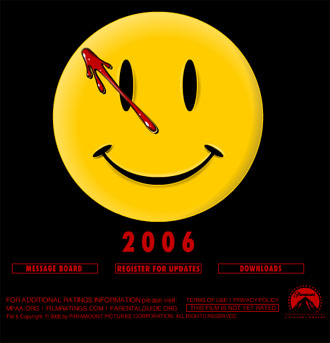
Looking for info on Wanted I came across a couple of refrences to Watchmen. The on & off adaptation of the what is possibly one of the greatest comics ever written. The film was officially canned a while back but just to remind you what we were promised:

1986
Alan Moore and Dave Gibbons create the Watchmen

2000
Studio - Universal
Director - Terry Gilliam

2001
Writer - David Hayter

2003
John Cusack - Nite Owl
John Cusack - Not Nite Owl
Location - Czech Republic

2004
Sigourney Weaver - Silk Spectre
Daniel Craig - Rorschach
Action - Filming to start 04 in prague
Director - Darren Aronfosky
Studio - Revolution Studios
Studio - Paramount Studios
Jude Law - Ozymandia
Simon Pegg - Rorschach
Director - No director

2005
Director - Paul Greengrass
Action - Filming to start 05
Action pre -production kicked off
Location - Pinewood Studios
Marketing - Paramount launch watchmen.com


Joan Allen – The Silk Spectre
Marketing - Downloads available @ watchmen.com
Action - Filming to start late 2005
Action - Requests go out for props
Action - Filming to start July 2005
Location - No loacation
Studio - No Studio
Studio - Warner Bros.

2006
Director - James McTeigue
Writer - None
Director - Zack Snyder
Writer - Alex Tse
Action - Screenplay almost complete


Friday, 1 September 2006

The Firm

The Firm (1988)
Plot Summary: This is the story of rival "Firms" of football (soccer) supporters, and how one man has a wish too team them up for the European Championships of 1988. However, when this is discussed, the opposing leaders, are not happy as the believe this is a challenge to their authority. This Film shows how football violence has progressed from pure violence to a form of organised crime, to the extent that all the leaders know each others home phone / mobile phone numbers.

I recently saw Green Street starring Elijah Wood (Plot Outline: Frodo a wrongfully expelled Harvard undergrad, moves to London, where he is introduced to the violent underworld of soccer hooliganism. AKA: Green Street Hooligans or Hooligans).

While browsing the web for info on the film (post viewing) it became apparent that to see a more realistic interpretation of the football hooligan lifestyle, The Firm is recommended. Made in 1988 for TV the film plots the inevitable decline of street fighting man Bex Bissell played by Gary Oldman. Bex is an Estate Agent by day and leader of a firm by night.

It was interesting to see Oldman in a his relatively pre fame , read OTT, performance. He eats the screen up as do the rest of the cast. Oldman seems to play Bex as part Travis Bickle and part, well Gary Oldman. This characterisation seems to be the template for all his future insane roles.


This is not typically the kind of film I would watch British films from this period are a little to gritty and dark (both in lighting as well as mood).

Oldman a fan of the Stanislavsky method, was at the time married to, and had a child with, Lesley Manville the actor/ess to play his wife and mother of his child in The Firm.

The Director Alan Clarke has a career spanning the 60's,70's & 80's. He passed in 1990. He seems to have specialised in TV movies and was possibly master of the gritty, made for TV, British working class underworld tales. His credits include almost every film of this type such as; Elephant, The Firm, Christine, Made in Britain & Scum. His 32 film career includes Road & Rita, Sue and Bob Too.

What's good: Performances
What's bad: Lighting and low production value or maybe this adds to the grittiness of the subject matter.
In the end: Interesting to watch if you are a hooligan or a celluloid/Oldman aficionado.

Monday, 12 June 2006

Best Practice for Time Travelers

The guys over at Idle words have compiled a list of best practises for time travellers. The 8 key points are:
  1. Act like you don't care whether people believe you
  2. Don't be afraid to make woolly predictions
  3. Read up on your physics
  4. Cover Your Ass
  5. Apocalypse, baby!
  6. Dazzle 'em with details
  7. Know your audience
  8. Watch out for paradox
It seems the list is gleamed from time travelling films from the last 3 decades. Still bloody hilarious read the detail over here!

Poster from the classic time travel mind bender Back to the Future.